Chapter Three: Studies 1945 - 1958
1945 to 1951 The Minor Seminary - The Grammar school in Sterksel and Esch
In 1945 the choice of secondary schools was not great. The small number of grammar schools, called gymnasia and lycea in the Netherlands, were mostly occupied by children of the higher Middle and Professional Class[1]. After completing a full Primary School the majority of teenage children were expected to be trained for skilled labour, and domestic science. Some of them were allowed to continue and were accepted in the Mulo, the Extended Lower Primary School, to be absorbed in the ‘production sector’ at the age of 15 or to receive further training in Nursing Schools and Teacher Training Colleges. The only grammar school for Catholics in The Hague was St. Aloysius College, ran by the Jesuits, situated at the other, more prestigious side of town.
Holland needed labour for the great effort of national construction and the big families, in particular the Catholics, needed income to supplement the wages of the father, the main breadwinner. Of my classmates many of them went to the trade and agricultural schools nearby, some became teachers and a number emigrated abroad with their parents.
For the young men and women, who felt they ‘had a vocation’, who wanted to do something special with their lives and for this receive secondary education the main and often the only choice was service within the Church as priests or religious brothers and sisters. Moreover the status of ‘someone who went into religion’ was very high and rendered a family respectable. Many parents prayed daily that one of their sons or daughters would become a priest, a religious sister or a brother. The fact that within this package of church ministry obligatory celibacy was one of the pre-suppositions, was taken for granted.
Preparation for the priesthood lasts a total of 13 years during which the candidate has ample time to reflect on what he is doing. During the first 6 years one attended a kind of apostolic Grammar school which was called the Junior (or Minor) Seminary while the last seven years, the Major Seminary, consisted of two years of philosophy, one year of Spiritual training in the Novitiate and four years of Theological training before final Ordination.
During this long span, from around twelve until 25 years the majority of the students would decide that the life of a priest would not meant for them and ‘leave’. For most of them the training they had received in the seminary became a step into the professional class of citizens and on the whole they were grateful for what they had received during their days in the seminary[2].
The joyful example of men like Fr Nico Hendriks made me decide to become a missionary like him and to go out to exotic countries. I was never attracted to the more ritual and liturgical dimensions of the so- called ‘secular priesthood’ of the parish priests and their curates. At first I wanted to become a missionary brother but, strangely enough, both my headmaster and the local priest told me that I was too intelligent for that vocation and had better become a missionary priest.
My experience of the war had made such an impression on me that my motivation could be regarded as serious, even at the tender age of twelve. The war had made our generation grow up quicker. I agree that my motivation might have been mixed. But does a pure motivation ever occur?
My parents, especially my mother, who as a young girl had not been allowed to become a teacher, wanted her children, and in particular her eldest son, to be given the opportunity of social advancement. Entry into the seminary was certainly a sure way of achieving this.
Personally the tribal wars of continental Europe with its misery of exaggerated nationalism, followed by a joyful liberation by the Anglo Saxon soldiers, made me vaguely aware that another world was possible, that human beings should unite whatever their religion, nationhood or ideology.
Finally the fact that I, as a little man in charge of the family, had ‘seen it all’ and wanted to move on and see what else life had to offer, might also have contributed to my saying farewell and leave home.
This ‘leaving home’ was not as dramatic as it sounds. I returned to the family hearth three times a year for long holidays. As a matter of fact, as this narrative will show, I might have been the first one to leave but was also the last one to close the door of our parental home in the Kokosnootstraat.
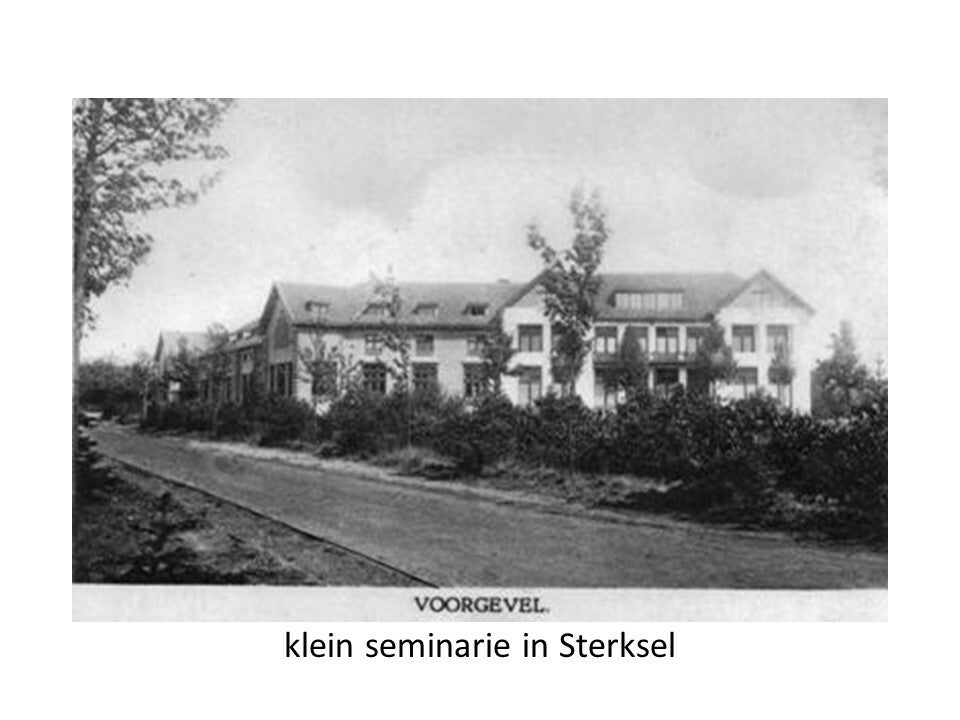
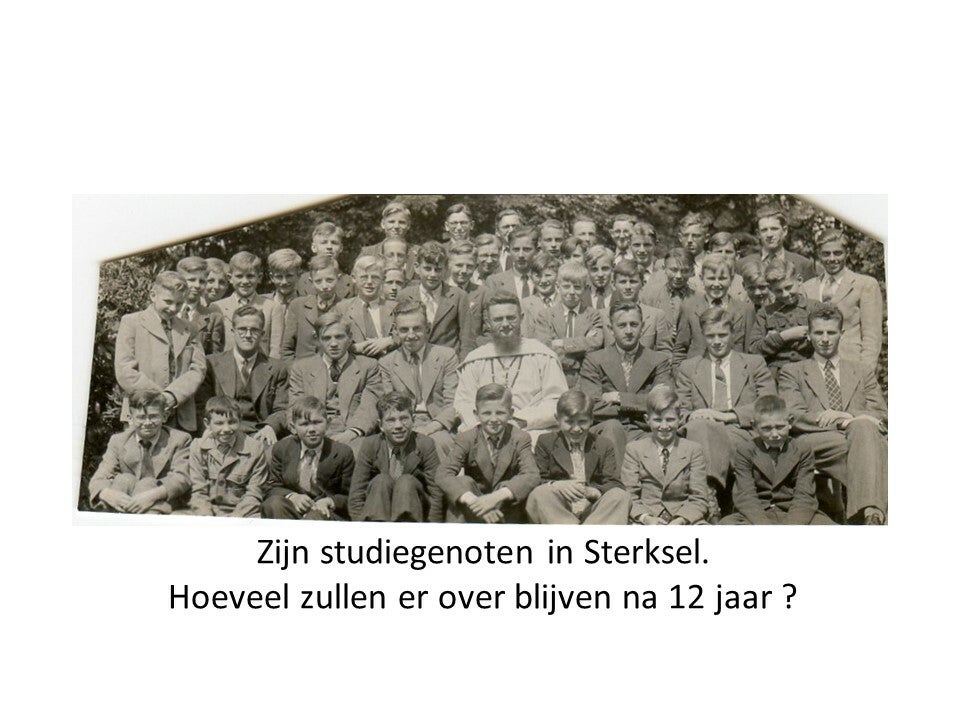
The little hamlet, called Sterksel, was situated in the south of the Province Noord Brabant, near the Province of Limburg on the border with Belgium. During the four years I was there we were taken on long walks for days on end during which I discovered how picturesque and peaceful the surroundings were. The only thing missing was the sea, according to me.
Long ago it had been part of a manorial estate owned by noble Cistercians nuns of Roermond and by the Nobertine monks of St Augustin in Averbode but since the Reformation most of the land had gradually come in the hands of industrialists like Philips of Eindhoven, and developers. In 1917 the area was cleared, opened up and drained for the exploitation of peat in view of changing the place into a holiday resort. A ‘Grand Hotel’ was built near the little railway station . The hotel prided itself of 20 modern rooms with warm water, showers, electricity, tennis courts, a kindergarten, fishponds and even hunting grounds! At first the project was a success but during the slump in 1924 the company went bankrupt.
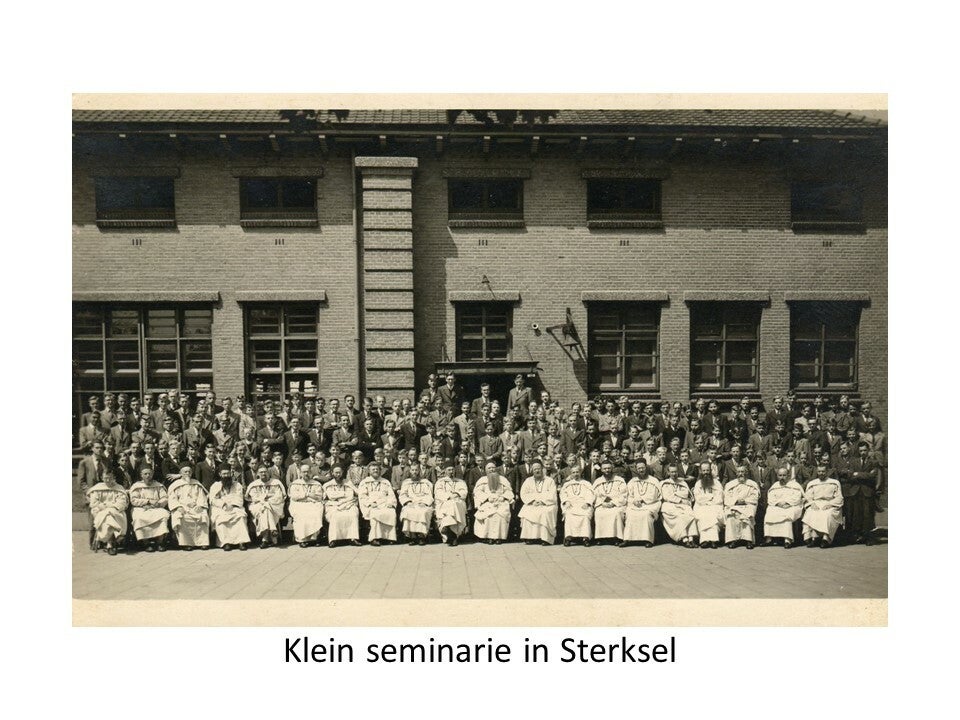
In 1926 the entire complex was bought for 15000 Dutch guilders by the shrewd Fr. Van Kersten, the first provincial of the White Fathers in The Netherlands and family of a cigar factory, called Willem II. He added wings, a convent for the sisters, a chapel and, later in 1932, an aula with a podium, stage and music rooms[3]. The entire complex was dedicated to St Paul, the missionary.
On the day of my arrival I was shown a little chambrette, in the loft of the aula. It was a small cubicle with a bed and cupboard, made of wooden panels and a curtain as a door. Each evening the priest in charge, called the surveillant, checked whether you had gone to bed after the ringing of the night bell. There was a common washroom with showers and wash basins, to which you rushed each morning to be the first. The class rooms were on the first floor. These were attached to a chapel with, in front, a statue of the founder of the White Fathers, Cardinal Lavigerie, breaking the chains of an African slave boy. There was a common refectory with rows of tables.
The food was prepared by a team of religious sisters of the Congregation of Christ the Priest. There main aim in life was to care for young seminarians during their training to the Priesthood. They had their own convent and we hardly ever talked with them! There were always a couple of kind brothers who looked after the maintenance and the farm of the house. I remember especially Brother Bavon who allowed me to work with him and showed me a nest of young kittens in his hay stack. They were hard working men who, with their golden hands, made sure that the St Paul’s College remained in running order[4].
The food was good but, as the Netherlands were still rationed with coupons, not always sufficient for a group of 150 growing young men. My friend Oscar Holleman from The Hague was so hungry that I gave him a portion of my butter, a herring and a few slices of bread[5].
I looked forward to the free days when we went for endless walks through the woods, over the fields, and along the sandy roads, not paved as yet at that time. There was a romantic fen in the woods, called Elias. I always wondered what the prophet Elias had to do with this pond. Later I learned that the estate had belonged to a Jewish family called Elias of which all the members fled to the USA just before the War. His villa had been burnt down and only the pond was left
There was another adventurous area, called ‘De Pan’ with, in the middle, an old farm with a thatched roof. Its property reached the border with Belgium. On free days the priests let us play in the endless woods from morning until evening to our hearts content. Somewhere in the middle of it all we discovered and talked with a real hermit, called Antoon who lived in a small hut. He owned a couple of huge boars with which he trekked around to sire the pigs of the surrounding farmers[6].
There were also numerous chapels, dotted all over the landscape. One of them, a very dark one, was dedicated to John the Baptist with his bleeding, decapitated head painted on the wall. I never felt much at ease in there but the other boys, who came from Brabant, seemed to be used to these gruesome pictures and did not mind.
Another holy place, reached after a long walk, was the Achelse Kluis. an encloistered monastery inhabited by the monks of La Trappe, the Trappists. Later, as senior students we made to follow a retreat in this monastery, where nobody spoke and where the monks were given to a contemplative life. I was deeply impressed by the beauty of their choir prayer, their beautiful gardens and their austerity but came away convinced that as God had given me a tongue I should make use of it.
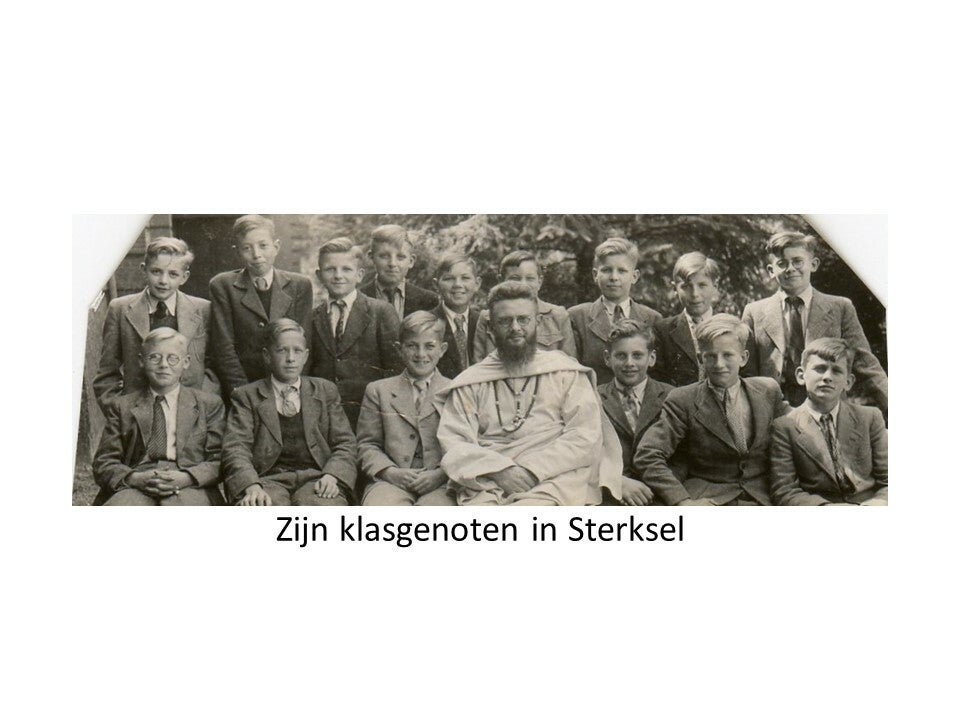
During the first weeks after my arrival I had to get accustomed to my classmates. There were so many of them in the first form that we were divided into two streams, A and B. Most of them were older than me as they had lost a year or two during the war. They spoke Dutch with the various the accents of the Netherlands and in the beginning I did not always understand them. The majority came from Catholic Brabant and some had already been in boarding school during their primary training[7]. I, and my friends from The Hague, were often singled out as having a posh accent, something I had never been aware off before. A few days after the beginning of the year another student arrived from The Hague, Joseph Planken who was almost four years older than myself. I regarded him as my elder brother who knew what life was about and who defended me against the bullies, which every institution of boys possesses.
We, the students from ‘protestant’ Holland, those who came from the north and west provinces ‘above the great rivers’ were regarded as slightly inimical to the students who came from Brabant and Limburg. I did not understand the reason why until we studied the History of the Catholic Church in The Netherlands and learned that for a long time these southern provinces had been neglected by ‘ those above the great rivers’ , in particular by the Government in The Hague.
I was not the only one who had been traumatized by of the war. The south and the east had been conquered by the Allied troops inch by inch. Each boy had his story of bombardment, street to street fighting, and days of life in the cellar. Some of them had lost relatives. After a short time we reached an unspoken agreement not to talk about it any longer and look into the new future with hope[8].
On the whole the White Fathers in charge understood that we needed healing and good care. I had only one pair of shoes and, to save them, I decided to wear the wooden sandals, my father had made for us during these long walks. They became undone and I could hardly move forward any longer. I was carried by the priest in charge and by a grown up student of the higher classes during the rest of the day. I was also allowed to enjoy my age again as I was not any longer ‘in charge of the family’ but the youngest, carefree boy of the class. The artistic Fr Hensen tested my voice and made me a member of the Schola, the choirboys who led the Gregorian chant during Mass and other liturgical services. He also conducted the main choir of soprano, alt, tenor and base singers. With the help of a Hammond organ and an excellent organist, Jan Reinders, we reach a relatively high standard and performed on most feast days.
The staff was not qualified and each White Father longed for the day he would be appointed for Africa. But what they might have missed in qualification they made up by their devotion and their genuine interest in our progress.
.
The parish priest and the headmaster had helped me to pass my entrance exams but soon after the beginning of the school year the teachers noticed big gaps in my primary education. In fact I hardly had received any teaching in the 6th class. For example I had no clue of grammatical analysis or parsing so necessary for learning other languages. And in Form One I was swamped by an array of new subjects like Latin, French, and Dutch literature. The priest in charge of our section, the kind educationalist Fr Jan Sars took it with a sense of humour and gave me extra lessons in the evening. For this I remain grateful to him all my life[9]. The rector of the seminary was Fr Frans Dirks, a small man with a long, reddish beard. He came in, now and then, to give us a spiritual pep talk[10]. Not all the lecturers were kind and helpful. The teacher who taught French had no pity whatsoever and seemed to pick on me for no reason whatsoever. Because of this I acquired an abhorrence of the French that took a long time to get rid of.
Once I had settled down in my new surroundings I noticed how much my mother missed me. I received regular, almost daily, letters from her and was consequently teased by my classmates who called me “a mother’s baby”. Little did they know what we had gone through at the end of the war and that between her and me an Oedipus complex had developed. I was homesick and wondered how I would get through these thirteen years of study before ‘going to the mission’.
The college had scheduled a retreat for the end of October. It meant three days of prayers, spiritual talks by a special retreat master and time for reflection, all in absolute silence. The retreat master had just given his first introductory talk when I was called to the Rector, Fr Dirks. He told me that my mother and my sister Toos had suddenly come all the way from The Hague to visit me and were accommodated in the small inn opposite the college.
I could not believe my ears. How had they managed to reach this forlorn place in the middle of nowhere? I was given ‘exceptional permission’ to go and see them but not to miss the spiritual conferences. I crossed the little road and suddenly my mother fell in my arms, weeping and crying. Then I heard the story. The kind driver of the transport company in the village had offered them places in the back of his lorry, filled with fruit and vegetables on their way to the markets in Germany. He would pick them up again on his way back two days later. Fortunately the weather was gorgeous, sunny with mild autumn temperatures. We walked around through the small village hand in hand, all three of us and stuffed ourselves with juicy apples. They were not allowed to go inside the premises, ‘so as not to disturb the students’.
My mother told me that the Rector, “combing his read beard with his fingers” had at first refused to let her see me as I ‘was in retreat’ Almost in tears she had replied that she missed me terribly and would not go back all the way to The Hague without seeing me. During the following days I told my mother and sister that I really wanted to become a missionary, that things were not so easy at the beginning but that I would overcome all difficulties. They waved me goodbye from the back of a now empty lorry and from then my parents, especially my mother and sister Toos, supported me wholeheartedly during the long journey to ordination.
In November the Rector announced the visit of a very important person, the Superior General of the White Fathers, Bishop Joseph Birraux[11]. We prepared a solemn reception for him and received him in the Aula with speeches, song and music. He gave a long speech in French during which he commiserated with us having suffered so much during the War. I expected him to give us at least two days of congé (freedom)but we only got one short afternoon.
On the 5th of December we celebrated Saint Nicolaas and each student received parcels from home. It was the first time I learned about common property as the contents of these parcels were put together in bags and redistributed to all of us by the Saint himself. He came from the village , dressed up as a bishop, sitting on a horse. It was the custom that each year one of the senior students of the St Paul’s college would act as Sinterklaas. Not everybody had ever ridden a horse and one day the student was so awkward that the white horse reared and threw off the rider very irreverently at the very moment of entering the grounds of the College.
Christmas holidays came. By then many of the railway bridges had been repaired and I reached The Hague safely without any trouble. My mother embarrassed me by running out, flying into my arms and hugging me endlessly in front of a couple of my fellow students!
During the following years she gradually got used to the flow of my leaving and returning. Later my brothers and sisters said that she was different when I was at home but in what way I never knew. It must have been a pleasant break for her in the often harsh routine of giving birth to and rearing so many children.
I wanted dearly to belong to the first ten of the class in as many subjects as possible. Again, the wise Father Sars encouraged me in this, with obvious enjoyment. I did not manage that first year, in fact I hardly scraped through but was determined to do better in the future.
Just before the start of summer holidays the rector, Fr Dirks called all the boys together and gave us some admonishment as regards our behaviour as ‘priest students.’ “Mixed swimming was taboo”, he said and in my innocence I thought first that he meant swimming with Protestants.
It happened to be a very warm summer and once back at home everybody went to the sea nearby for a swim. I told them that, since I was a priest student, mixed swimming with girls was forbidden. My mother laughed heartily and told me ‘to leave these strange rules in the seminary’. Once on the beach we all stripped heartily and dived into the high waves without much ado.
When I returned to Sterksel in September 1946 to start the second year I found that a number of students had second thoughts and had left the seminary for a junior secondary schools near home.
The regime became more Spartan and the time table kept us occupied from very early morning until late at night. Each evening, after a series of morning and afternoon lessons, there was a two hours period of study, supervised by a priest with only a break of quarter of an hour in the middle. At first I was at my wits’ end to get through it but slowly I learned to do my ‘homework’ from the more difficult to the more pleasant tasks. From these early days the White Fathers taught us to dedicate two hours of the day to study, something that later proved to be very useful when trying to acquire the language, culture and customs of the people in Africa.
To the already long list of subjects, Greek, English and Algebra were added. Coping with all these subjects remained a major challenge but gradually I caught up and did not belong to the last of the class any longer. Life became harsh during the long winter of 1947. Temperatures remained below zero until the middle of Lent, near Easter. Food was still scarce, heating was not sufficient and many students became ill. We spent hours skating on the little streamlet and the ponds of the estate but found it difficult to study. The rectors and his staff were aware of the responsibility of having to care for the health of roughly 150 students. They were at the point of sending us home when finally spring came. Meanwhile, at the end of January another little sister had made her appearance at home. At baptism she received the name Maria Anna and was called Marian[12]. She always remained a source of light and joy after a long and dark winter. I was allowed to be her godfather, but had little knowledge of what it entailed.
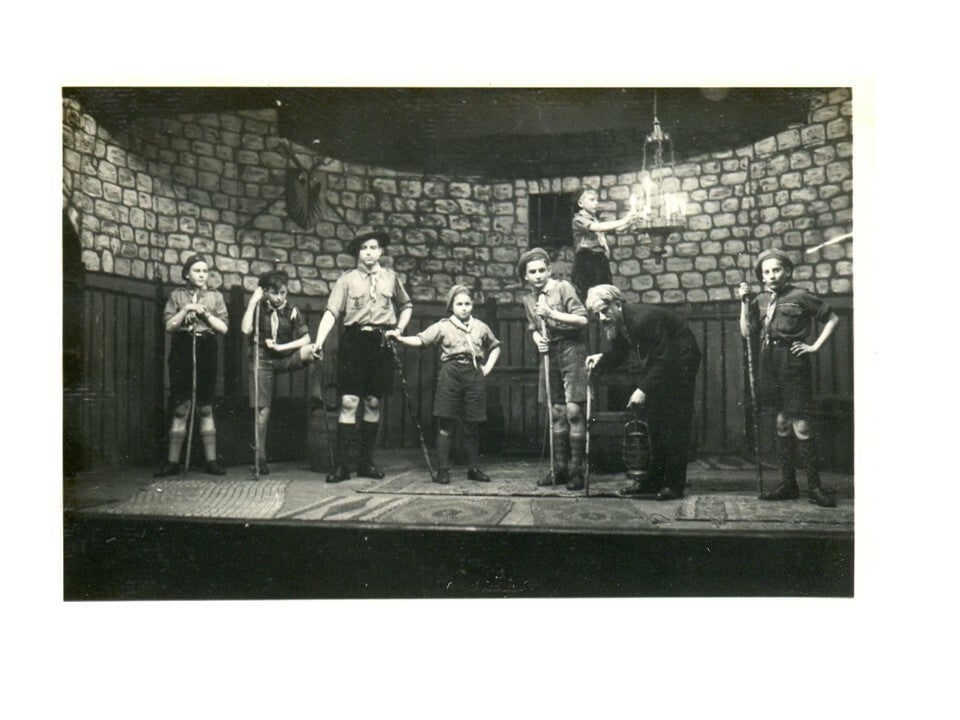
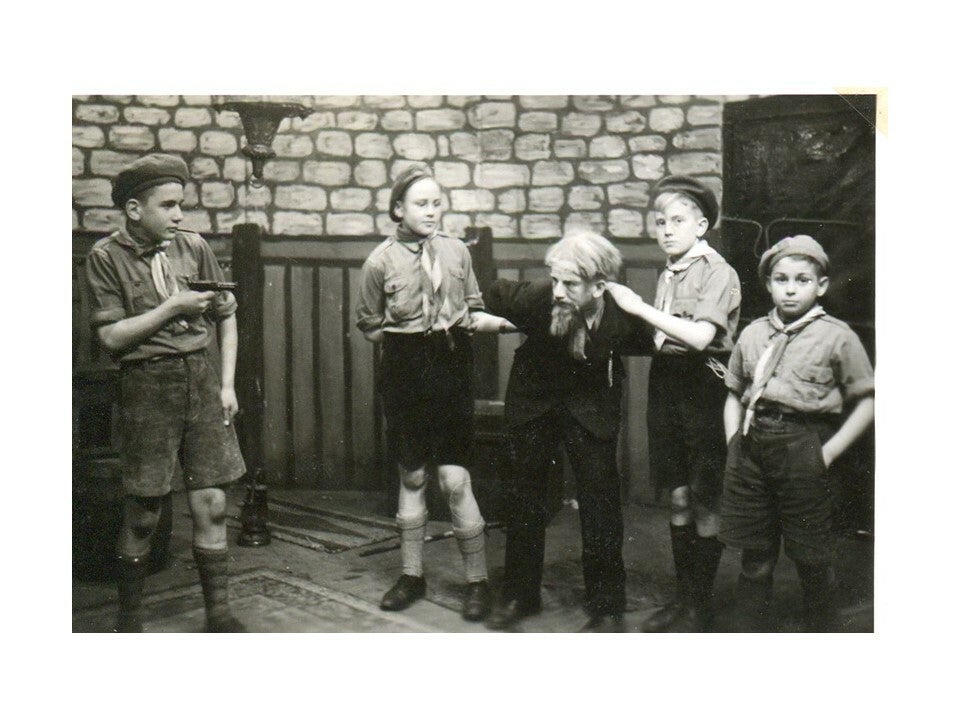
The care the priests took during that extreme winter brought us nearer to one another. They continued their lessons with great regularity, tried to keep us comfortable and reasonably well fed. There was the introduction to the classics, and the modern languages but especially a great deal of culture, history, and art. With Fr. Ruud Hensen as conductor we sang religious music and Masses of Mozart, Beethoven, Palestrina and Brückner. He made us listen to and explained classical music. Each year ended with a play, a Greek drama or a modern an exciting detective story. Besides the long hours of study we played football and tennis, roamed around in the woods and enjoyed the annual carnival and sports days. There were also the liturgical feast days. I remember especially the Blessed Sacrament Processions, held with the people of the village and accompanied by the village brass band. Later, much later, I was able to draw from what I had received and impart it to my students of philosophy in Zambia.
Nevertheless the seminary remained a private school and was not recognized as an official institute of learning by the Dutch State. In 1947 when I reached the third year, called ‘Grammatica’, Fr Herman Hartman became in charge of the Dutch province of the White Fathers[13]. Hartman had been an officer in the British army and was a man of the world who understood that the standards of future missionaries had to be improved in order to cope with the exigencies of modernity. He and his council decided to send a group of the newly ordained priests for further studies in order to obtain a university degree and to select as many students as possible for an external and recognized State exam. Not all pupils were chosen to sit these tests but, all the same, Hartman’s decision improved standards and rendered academic pursuit more serious among the teachers and pupils alike He also opened a house near The Hague, in the seaside resort of Scheveningen in order to have better contact with the world at large[14].
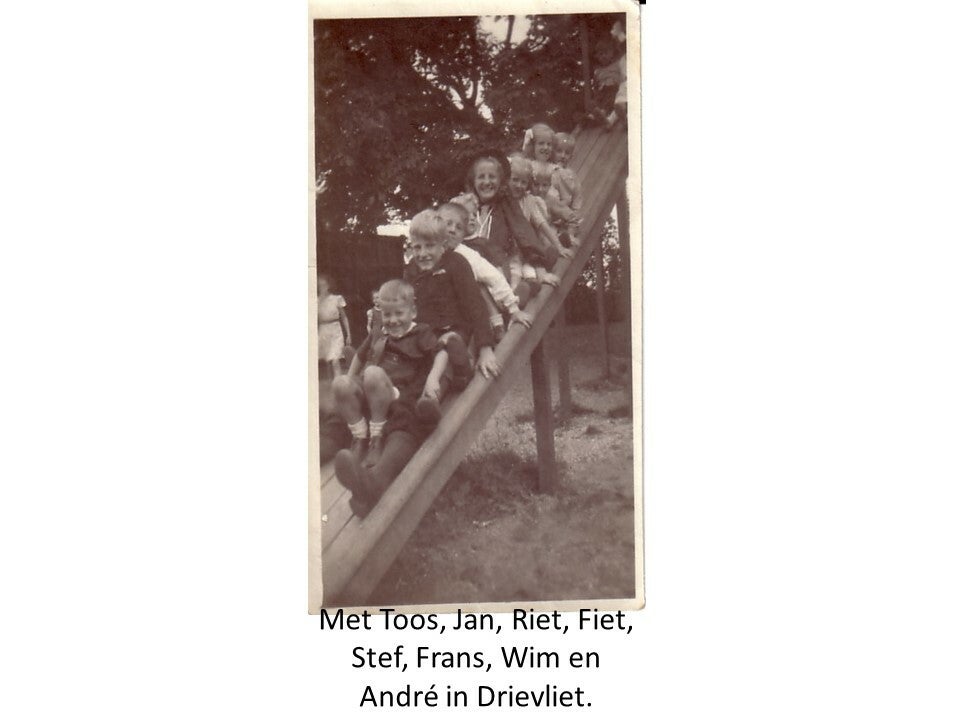
At home my brothers and sisters were growing up. Toos had finished her Domestic Science School and was the first to contribute to the family income by working in various households. She had her first dancing lessons and appeared to enjoy life. She always had a great admiration for all that I was studying ‘ at the seminary’ Jan went quickly through the junior secondary and decided to become a teacher. Like my father he had two golden hands and made a beautiful dove-till in the garden. He collected the material from old building sites as he had no money to purchase anything. Even the pigeons were given by a kind neighbour.
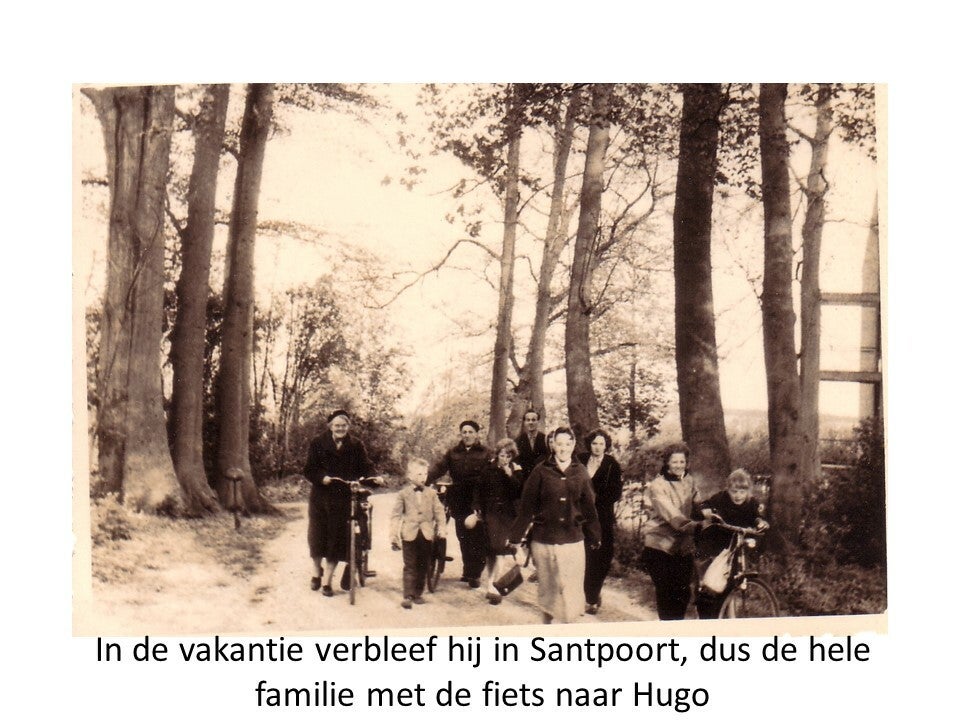
The small house in the Kokosnootstraat became full and was never quiet, especially during the holidays. But it never seemed to hinder us. After the poverty of the past and the destruction of the war, the second half of the 1940s and the 1950s were years of re-construction. ‘Marshall’ Aid and good governance in the Netherlands enabled the families to make little but firm steps ahead and look into the future with hope.
But holidays away from home to another town, let alone to another country were beyond the means of the workers. The Catholic Labour Movement. K.A.B. devised a scheme by which families could exchange their children during holidays.
Two of my younger brothers, Stef and Frans went to a family in Echt ( Limburg) and two girls, Tinie and José, nicknamed ‘Zus’, Gispen came to us. They came primarily for a holiday near the beach and fortunately that summer was a fantastic one. At first they were shy, even prudish but after a few days they became so lively and lighthearted that they became popular and played to their heart’s content[15].
A year later, our two girls, Riet and Fiet, went to Schoorl in North Holland, exchanged for a young girl called Jannie Wilder. She had long legs and ran like a deer through the streets. Soon she was called Fannie, after the famous runner Mrs Fanny Blankers-Koen who obtained a set of gold medals for the Netherlands during the Olympics of 1948.
On the first of September 1948 Fiet went ‘to the Lauriergracht’ in Amsterdam. After she finished primary school in Loosduinen, the sister in charge thought that Fiet might have ‘a vocation for the convent’ and suggested my parents to have her sent to their boarding school in Amsterdam.
We were healthy, happy and did well at school. My father went to work each morning after a quick Mass in the small church and came back to us in the evening. That was always a lovely moment as he seemed to bring joy and peace to all of us, including our mother. He would always give a warm hug to her, and, after a cup of tea, go into the kitchen to help her preparing the enormous amounts of food, necessary to feed the family. And then those beautiful long evenings together, when ‘the little ones’ had gone to bed and we talked together. He was a natural philosopher, deeply but not fanatically religious and soon treated us as equals. We wanted the hours to last, talked, argued, and reasoned until late in the evening, sometimes even after midnight. Next morning my father had to rise early again to be in time for a quick morning Mass and on to work.
When I passed from the third (Grammatica) to the fourth form , (Syntaxis), I was 15 years old and had entered puberty. I lost my place in the choir as soprano and was not regarded good enough to rejoin as a baritone or base. But the feeling of growing up, suddenly being a head taller than one’s parents, and being put in charge of various activities, was great. The world became one’s property, prepared for the young generation to which I now belonged. My determination to get on with my studies and go out to Africa was so strong that I easily dispended with any thought about anything else. The young girls I had known since childhood grew up, became beautiful and attractive, groomed themselves for dancing lessons but this ‘was not for me’. I remained convinced of my call, my vocation and never thought of an alternative.
More of my fellow students decided to leave and the double stream dwindled to a single one. One very hot summer evening, a student next to me suddenly gave a big sigh, closed his books, stepped out of the open French windows of the seminary in Sterksel and got himself a lift home without being noticed by the surveillant. This caused great consternation among the staff but his parents received him with humour and understanding.
Jan Velthuizen, with whom I had come to Sterksel in 1945, also decided to leave for another way of life. I missed him dearly but, happily, we would meet each other again, later in life.
In 1948 the staff of the seminary was rejuvenated by newly ordained priests[16].They came with a post-war spirit as some were only a decade or so older than us. All of them were intent of ‘not settling down as teachers but going to the missions’ after a few years of service in the home province. It gave the seminary a young and happy spirit. They worked and looked for things to happen in the future and, indeed, we met each other later on in Africa. I remember that year vividly because of all the ‘acting’ I was asked to do. I enjoyed this tremendously and so learned how to talk and speak in public without being shy or hesitant.
In September, I received a telegram from St Tholen, the midwife, who by then had become a friend of the family. She wrote me that another little brother was born, called Sjon.
By then I was in my last year ‘in Sterksel’ as at that moment the last two classes (forms) were accommodated somewhere else. The number of young boys who wanted to enter the Junior Seminary remained so high that the White Fathers decided to move their philosophy from Esch, near Boxtel (Den Bosch) to their house of Theology in s’Heerenberg in the East. Thus the house in Esch became free to accommodate the last years of the Junior seminary, From 5 (Poësis) and Form 6 (Rhetorica).
The hamlet Esch, near Boxtel, in an area called Hal, was not new to the White Fathers. This swampy terrain had been donated to them by a baron, called Alphons Van Rijckevorsel, when they arrived from France in 1892 in order to establish the White Fathers and Brothers in The Netherlands[17].
The property was situated on the main connection, Den Bosch-Eindhoven near a crossroad from Esch to St Michielsgestel, a village where my maternal aunt, Sr Hugolina looked after the deaf and dumb children. As soon as I was settled I walked to her convent and visited her. The Institute had a huge bakery where almost all the hosts, the wafers for the Eucharist, were made for the parishes in the Netherlands. I was impressed by her dedication and her down-to-earth approach to life. Later they sent us to the orchards of the farmers nearby to pick apples for the winter. I always made use of such an occasion to go and visit her. We talked together for hours. She confided to me that she always had wanted to ‘go to the missions’ but was never given permission.
Again these last two years of the humaniora, as the Grammer school was called, were occupied by daily study but also by a great deal of culture. Fr Gerard Kapteyns was in charge of Dutch literature and introduced us to the modern writers and poets. We played football but also hockey and volleyball. Nearby in the woods were huge ponds and fens in which we swum on free afternoons.
At the beginning of the Poësis in 1949 the candidates for the State examination were chosen. To my utter dismay I was not one of them. After all these years of hard work to catch up and again belong to the first ten of the class, my grasp of Mathematics was not up to scratch as my marks remained far below average. I experienced this as a major set back and made the resolution to somehow make up in the years to come. The fact that I was not chosen for the State Examination made me passive and even a bit morose. It was the first time in my life that I did not achieve what I wanted
During the holidays at home I really came to life. Together with my brother who was in the Teacher Training College we were accepted as youth leaders to look after inner city children. During the long summer holidays the municipality took them by tram or other free transport outside the town in the dunes where they played all day. It was our task to keep them busy, out of mischief and happily occupied. Both of us had experience with children and we never had any trouble with them.
We organised football and other sports competitions, long walks through the dunes and made them sing happily in the trams on their way back through the town. They were delightful children, easy to please and very generous. For this youth work we were paid rather well and at the end of the holiday we had earned more than enough for our pocket money for a holiday trip and for the coming term.
The first time, in 1950, we, my brother and I, went for a long cycling trip through the whole of Holland. We visited the friends we had made in Schoorl, crossed the great dyke to Friesland, where Jan had stayed during the war of starvation, continued to the Grispens in Limburg , then cycled back to The Hague via the camp in Brabant where Toos camped with a group of girl guides. I remember how shy we were when we found ourselves among a buzzing swarm of teenage girls.
In June 1950 Carla was born, the last and no 13th of our huge family. I remember very little of her birth as I was in the middle of the examinations. It must have also been the year that I cycled with Fiet to Amsterdam. She wanted to visit her ‘foster’ parents in Wolvega. We prepared a few sandwiches in the early morning and cycled towards Amsterdam, where she was to take the boat to Stavoren in Friesland by ferry. It rained and the wind was strongly against us. I was worried about her, going alone all the way and gave her all my remaining sandwiches and other foodstuff. She reached her destination but I became so tired on the way back that I almost collapsed from exhaustion. Fortunately kind people told me to leave my bike in a restaurant and gave me a lift to The Hague. I had to walk the last few miles and knocked on the door of my parents around 2 a.m.
The following year, after I had finished Grammar school, we became more audacious and cycled all the way to the very end of Luxemburg via Eupen-Malmedy. There we saw the ravages of the great battle of the ‘Bulge’ in the Ardennes. In Esch-zur Alzette we were accommodated by a generous farmers wife who lived in a huge ‘Roman’ farm Her only demand was that we wrote our names in a visitors’ book. It was obvious that she enjoyed being hospitable. Later on in Zambia I once told that event to one of my Luxembourg confreres, Fr.Jean Flies. He laughed and said that by the way I described the farm we must have been received by his own mother who loved to accommodate young students and kept the visitors book until the end of her life.
I had completed the Humaniora, and was ready to pursue the study of Philosophy. This was on tertiary level and the term started later than the Gymnasium. I had some weeks on hand and asked my father whether the furniture factory where he worked could offer me a few weeks of employment. I arranged for me to work in a workshop where young men stood behind the conveyer belt and mass-produced wooden toys for children. I will never forget these three weeks. We were paid for the number of toys we made each day. We stood for hours in a row with each one of us a task to do as quickly as possible, like hammering a few nails, sawing a small plank, gluing or saw dusting, and finally painting. At the beginning the other young men shouted angrily at me, as I was much too slow and held up the production line. They had only two topics of conversation: girls and sports.
That evening I cycled back home along the Hobbema Square with my father together with hundreds of other workers. I told him that I could not cope with the boring routine of that kind of work, was not quick enough and found the wages very low.
“Do not give up” he said with a smile. “First of all, it is a good experience for you, as student, to know what others have to do for a living and secondly I predict that after a few days you are as quick if not quicker than the young men next to you”. And so it happened. It was an experience I would never forget.
In later years when the world seemed to be obsessed with pedophilia I was asked whether abuse had occurred during our days in the minor seminary. As in most all institutions a certain amount of it happened from time to time. Some of the priests had a preference for little, sweet looking boys and paid more attention to them than to others. They were looked down upon by their students while their protégés were being teased mercilessly and being called “Stroop Likkers, Trickle Lickers”. For so far I know, any sign of homosexuality or pedophilia was quickly detected via mutual social control by teachers and students alike.
From time to time we were given a wallop, even a beating. This was not an experience that was quickly forgotten but one should not underestimate the resilience of kids on their way to manhood. It was regarded as part of the rough and tumble of adolescent life. Anyway we all were to busy ‘getting ahead’ after the ravages of the war to give much attention to, and be traumatised by these events.
If there is any negative remark to be made on these years of secondary studies, then it is that most of us were not given any recognition, diploma, or certificate after long years of studies. This was a great handicap for those who left for another vocation and, at least for me, proved to be a difficulty in later life.
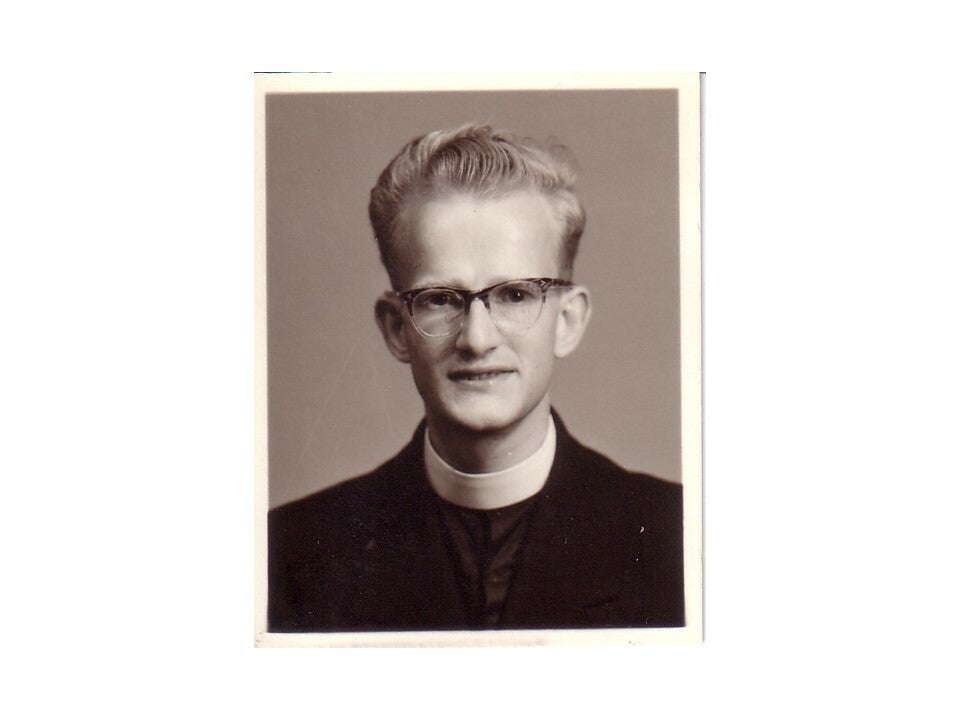
With the money I had earned at the end of the grammar school I was able to pay for the clerical suit, necessary to enter philosophy. To be honest, I did not look forward at all to walking around in a roman collar at the age of 18 but rather looked back to and remained grateful for a solid classical education, interspersed with days of freedom and rest, given by the White Fathers in Sterksel and Esch
[1] This had been a policy since the second half of the previous century. H. Hinfelaar, 2006. A Biography of Mgr Van Sambeek, 1886-1968 Manuscript for publication by White Fathers, Missionaries of Africa, Rome.
[2] Sample research during reunions of class mates 2000-2005.
[3] Henzen, R. 1966, De Geschiedenis van Sterksel. Het St Paulus College 1926-1965. Maandblad Afrika. Due to a shortage of vocation, the White Fathers sold their minor seminary to a foundation of artists in 1964/65. Later it was raised to the ground and no memories remained whatsoever. Much later on 18 May 2003 the Right Rev. A. Hurkmans, bishop of Den Bosch unveiled small statues of a White Father, a Brother of St Joseph of Providentia, (1920-1991) and a White Sister, (1950-1990) in front of the Parish Church.
[4] Bro Bavon: Gerard Vrientz from Breda was born in 1887 and died 04-02-1976. Also the gardener, Bro Marie,(Martijn Brugmans) born 1884, died in Sterksel 30-12-1960.
[5] He left in the Senior Seminary and lived in many places of the world as an Archivist to the Dutch Embassy and married late in life. In 1983 I met him again with his wife Lucy and he still remembered my generosity!
[6] His name was Antoon Vanden OudeRijn, a son of a well to do farmer. During the war he called his boars Hitler, Mussolini, Rommel, etc. He left Sterksel at the beginning of the 1950s and was not seen again.
[7] They were from middle class parents who send their children to a Lower Primary Boarding School called Ruwenberg. At that time the greater majority of priests and religious came from the middle classes.
[8] Their stories emerged in later life during interviews (1996-2004). A confrere, Henk VanderPaverd crossed the Yssel lake during the war in a boat full of rotten potatoes. Others walked the 35 km along the Dam to avoid being shot at by the planes.
[9] Born in Den Bosch, 1909, died on 21-07-1994.
[10] Born 1899, ordained 1926, taught 19 years in Sterksel and then in Santpoort until 1953. He died in 1958. Other teachers were Frits Muller, 1915-2000, Bart Sleutjes, 1918-1994, Piet Essers, 1912-1985 and Herman Bollinger, 1906-1988, Arnoud VanDoorn, 1914-1976, Martien VanStraten, 1912-1968.
[11] Born in Annecy, France, in 1883. After his ordination in 1911, he went to Karema in Tanganyika where he served as Vicar Apostolic. He became the 3rd Superior General in 1936. He died on the 30th of April947
[12] She was followed by Sjon in September 1948 and Carla in June 1950. Later a last boy was born, called Benny, but he was not viable and died after a few days.
[13] Born in 1907,ordained in 1933, missionary in Tanzania and chaplain in the British Army. In 1956 he returned to Tanzania and worked for another 20 years. He died in the Netherlands in 1978.
[14] The house, in the Helmstraat 3, was closed in 1951 when it moved to Rotterdam.
[15] ‘Zus’, Josephine Gispen emigrated with her husband to South Africa and lives with her children in Capetown.
[16] Fr Veltmann, born 1922, ordained 1948, died 1993; Fr Reynen, born 1920, ordained 1948, died 1991, Fr Theo Sanders, born 1914, died 1985, Fr VanderPol, born 1921, ordained 1948, died 1996, etc. One of the founding fathers was a Frenchman called Fr Louis Jamet and the other was called Fr Sjaak DeLouw and came from The Hague.The latter is alleged to have said just before he died: “I have tricked and swindled quite a lot of people during my life. The trouble is that I will not be forgiven by the Lord as I do not regret it!”
[17] ……………………………..??