Chapter Three: Studies 1945 - 1958
September 1951 to 1953 - Philosophy
The clerical attire, complete with Roman collar, did not suit me at all as I still looked very young and found myself unnecessarily restricted. But to the science of philosophy I took like a duck to water.
For the first year we went to ’s-Heerenberg, in Gelderland, on the border of Germany. Its extensive gardens and orchards were actually in No-Man’s-Land between the two countries. The buildings were solidly constructed by German Jesuits who had been extradited by Bismarck during the anti-catholic period of the Kultur Kampf around the turn of the century[1].
The entire property was sold to the White Fathers after the Jesuits had returned to their homeland[2]. The surroundings and the grounds themselves were near the flood fields of the Rhine that had a charm of its own. However the house itself was so huge that it never could be heated properly during winter time.
We, philosophers, occupied the highest floor with small rooms and poor furniture.The Rector, Fr Joop Geerdes, and his staff tried to make the best of it. I remember in particular Fr Jan Derks[3]. The lecturers had degrees from Rome and Louvain universities and on the whole they were broadminded and had a wide vision. Within the straightjacket of Neo-Thomistic philosophy they managed to broaden our minds with the teachings of modern philosophers. Above all, they made us think, reflect and reason by ourselves and not accept passively what was written in the manuals.
The atmosphere of the seminary had also been renewed by the arrival of candidates from other colleges. Some came from day Grammar schools or boarding schools run by other orders and congregations. I remember specifically Pieter Reesink, a bright student from the seminary of the secular priests and Piet Kooiman who had done his humaniora with the Franciscans in Venlo in Limburg. All of them had successfully passed their end examination. Then there were those who were called ‘late-vocations’ These were more mature men who decided to become missionary priests after ‘life in the world’. One of them was Theo Winkelman, fourteen years older than I. After working as an accountant for a bank, he had first joined the Trappists. The Abbot had told him after a year of probation that he was too active for the contemplative life and advised him to become a missionary. Together with others he had been schooled in Schola Carolina near The Hague, run by the Jesuits, specifically for men like him. Their knowledge of Latin and Greek was weak but they contributed greatly to our formation by their maturity and devotion.
The Rector loved music and played the violin. He discovered that some of us also played musical instruments. In fact one of the candidates who had joined us, had been a professional trumpet player, in the well- known Residency Orchestra of The Hague. Another came from a musical family and played the violin almost flawlessly. Then there was me, with the clarinet, Joop Harding with the flute and Jan Rademaker on the piano. Geerdes assembled us together, bought light classical music and made us practice the parts until it sounded melodious and attractive. For me the dullness of seminary life, the humdrum of lessons and the daily routine of spiritual exercises lifted as soon as we came together and played the first tunes of these parts of chamber music to our hearts’ content.
It was not to last. One day a ‘Father Assisant’, a representative of the Headquarters in Rome, called ‘The Generalate’ or ‘The Motherhouse’, came for an official visit. His name was Fr Henri Coté a rather military, no-nonsense kind of man[4]. He might have been a good superior but he was certainly not musical. When he happened to hear us practicing he called the Rector to his room and said:
“I want you to stop that cacophony. It disturbs the students. What we need in Africa are not artists but hard working missionaries, who know how to run large parishes”.
And that was the end of our ensemble and the end of me, playing the clarinet. Our professional trumpet player left and returned to play in the Residence Orchestra, the violin player emigrated to New York, where he earned his first income by playing in an hotel[5].
This so arbitrary command came to me as major shock I could not believe that one man, from Rome, could order an end to something so beautiful and so life-giving. As someone who must not have been musical, if not tone deaf , he might well have forgotten the impact of his command the minute he had written his report, left the house and was on his way back to Rome.
For me it was something I would never forget and for the first time I nurtured doubts, not so much about my ‘vocation’ but about the society I was to join. I had a good look to my elder fellow students who had gone through the rigours of the novitiate. Many had been talented young men during their humaniora but now seemed a bit dull and subdued as they had been asked to sacrifice the very talents that had made them so attractive. Was this what would be expected from me?
It was not be the last time that an, apparently so capricious, order of one person who happened to be ‘in charge’ would have such negative consequences. Buit at that moment I remained ready to take the rough with the smooth on the long and arduous road to Africa and was ready to do almost anything to reach it.
Toos, my eldest sister, had always showed great interest in my ‘studies’ but one day she met a tall and handsome man, Chris Lampe, who had just returned from army service in Indonesia. They fell in love and married in the early summer of 1952.
She was the second person to leave the Kokosnootstreet 58 and with her husband moved to a new quarter of The Hague. Even during the two years during philosophy I worked as a youth leader for the children of the inner city. I discarded my clerical suit and collar in their new home, and changed into casuals for my work with the kids in the dunes. In the evening I returned, and became a cleric again after a welcome cup of tea from my sister. I regarded it as a good solution and I enjoyed the conversations with her and her husband after he came back from his work.
The next year in February, their first child was born. She was called Hanneke and became the first of a forty nieces and nephews and an ever growing number of grandnieces and grandnephews
Also I remember that time because of a hilarious event that happened during that same long summer. Before we left ’s-Heerenberg, the rector, Joop Geerdes had severely instructed us not to discard the roman collar and our clerical attire.
“Noblesse oblige”, he said “You are now called ‘reverends’ and must keep to your new status”.
Theo Winkelman, our mature fellow student was an ardent yachtsman and another classmate, Joop Harding, came from Abbenes, a small hamlet along the famous Kagerplassen (Kager lakes) between Amsterdam and The Hague. His family possessed a dingy. Together we decided to go for a few days of sailing. We kept to the strong order of our superior and sailed around dressed in roman collars amidst other crews in shorts and bikini’s. Suddenly we saw from afar a middle aged man in shorts and with a well kept beard and moustache. “It must be a artist”, we said. But when we drew nearer we discovered to our great surprise that it was our very own superior sailing with his brother, also a priest, both without roman collars! We shouted so loud that they had to recognize us. Once our rector had boarded our boat he said a bit sheepishly:
“Well, I make an exception. During sailing you can take off your clerical dress!”
It became a good and relaxed day. Later in the early evening we dived from the boats and went for a swim. With his corpulent figure he had difficulties climbing back and asked us to hoist him in. As a punishment we dropped him back in the water again and again when he was almost in the boat. He took everything with great humour and from that day onwards he became much more relaxed as regards all these ecclesiastical rules and regulations[6].
I heartily enjoyed my younger brothers and sisters all growing up in good health. During Easter holidays I took them out for long walks. We would start off in darkness, around 5 a.m. and walk through the dunes and along the beach all the way to Scheveningen. There we went for Mass, after which we bought a cup of soup, ate our sandwiches and came back by tram. Nelty pleaded to join us but she was regarded as not strong enough. She would never forget the day we finally decided that she was up to it.
In spite of all frugality it was a good time as the whole family moved slowly forward to better times without any mishap or misery. The house was always open; everybody could walk in and out. Many would remember this hospitality all their lives[7]. My father loved young people and founded a music band, called ‘The Banjola’s’. During weekends he taught the teenagers to play the guitar, banjo, mandolin or other stringed instruments and performed with them at al occasions in and out of town. He continued doing this for almost 25 years. It became a very popular group.
He always was a bit of a charmer and to our great hilarity caused my mother to be jealous when he came to near the teenage girls when pointing out the notes on the score!
There was also plenty of sport, mostly foot- and handball. After the game the players came to the Kokosnootstreet for a cup of soup and a sandwich, that my father had prepared for them. They could stay as long as they liked. In the evening they all went for a dance in the local parish hall where the curate made sure they kept to the straight and narrow and went home, back to their parents in time. Later this style of life would be called: Het rijke Roomsche leven! The rich Roman Catholic life. The boys went camping with the scouts and the girls with the guides, all within the framework of a hard working parish community.
For the second year of Philosophy we moved back to St Charles near Esch (Boxtel). The White Fathers had opened another minor seminary in Santpoort, near Haarlem. The first years of the Grammar school (Humaniora) remained in Sterksel, while the last three classes, grades went to the new building in Santpoort. Esch became a philosophy again and ’s-Heerenberg catered again only for the novices and the theologians.
We were asked to help with manual work in the grounds of the new building and with moving furniture and books from one building to another. That second year, from September 1952 to July 1953 passed very quickly. I loved all the subjects of Philosophy, Church History, Psychology, Sociology, etc. and obtained high marks.
These were promising years when gradually the nations of Europe decided to work together. The first hesitating step was the Benelux, collaboration between Belgium, The Netherlands and Luxembourg. This was followed, in 1951 by a coal and steel agreement by the two traditionally arch-enemies, France and Germany. The ideals of our generation of that time was the unification of Europe built on the foundations laid by men, like Adenauer, Schumann, Spaak, Monet and other politicians of that day. These were dreams that stayed with us all our lives.
Unfortunately there were hardly any examinations at the end of Philosophy and again we moved on without any official certificate or diploma.
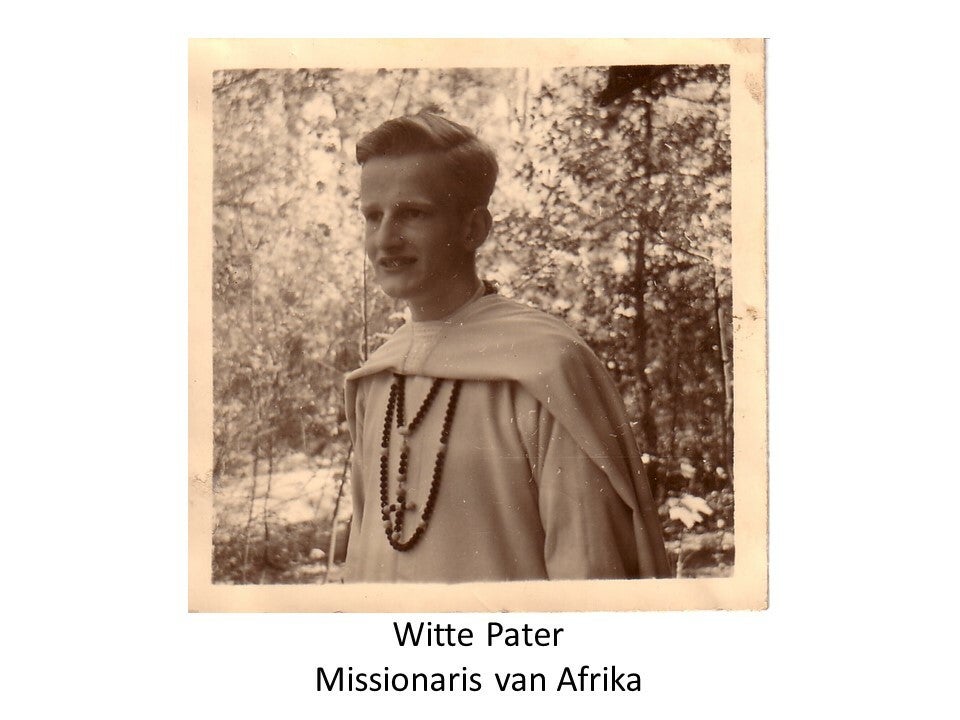
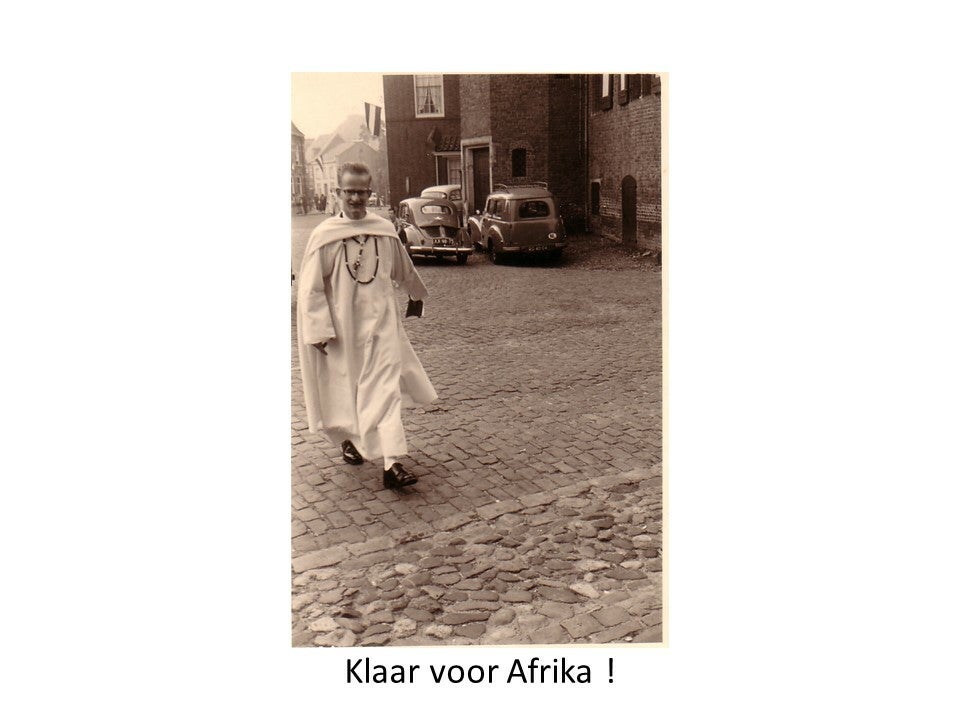
The year that followed was to be spent in the Novitiate, a year of spiritual training and probation. The clerical attire of a black suit and roman collar was to give way to the specific garb of the White Fathers, the so called ‘gandourah’, and a ‘burnous’ both made of expensive woolen material.
Part of the expenses was to be covered by a personal contribution. To help my parents I accepted a full time job in the nearby market garden of a Mr. Steyn. He was a devout catholic and regarded it an honour to have a future priest working for him. He paid me very generously in spite of me being unhandy and slow at times. I had to be there at six o’clock in the morning to pick tomatoes, cucumbers and other vegetables. The products had to be wrapped in paper and put carefully in special boxes. They were then quickly transported on the ‘Westland’ barge that was waiting in the small canal between the hothouses and with a ‘boom’ (pole) pushed to the auction floor in Loosduinen. I was told that some of these fresh products would be for sale in Germany or in Britain that same day.
It was tough work and my fellow workers, mostly fathers of families, were exacting. One hot afternoon I had to push a big wheelbarrow full of fertilizer from one hothouse to another over a narrow plank that bridged a small ditch. I lost my balance and fell with the wheelbarrow and all into the green slimy water. I felt ashamed to have wasted money but everybody, the owner included took it as a great joke.
”The young priest fell in the ditch”, they laughed, “We will catch enormous fish next year!”
It was also the last time I worked for the municipality as a youth leader among the inner city children of The Hague. We, the leaders, had grown up into mature young men and women who knew that we were on the threshold of adult life. Many, like my younger brother Jan, would start a career as teachers or social workers. We had become friends and we found it hard to say goodbye to one another.
The administration organised a farewell party and thanked us for the work we had done for the community. On my way home I walked together with a young lady of whom I had become very fond and who had ably looked after the girls all those years.
“What are you going to do, now that you finished your training as a teacher?” I asked
“I will enter a convent and become a nun”, she said simply.
When I told her that I was going to the Novitiate to become a missionary she shook my hand and said “That is great” and walked away.
Novitiate and Scholasticate September 1953 – July 1958
I had reached the last episode of my training by the White Fathers to become a missionary of Africa. I arrived in the village of s’Heerenberg much too early and decided to take a drink in the small restaurant opposite the buildings. The owner chatted with me, asked where I was going.
“I am entering the monastery over there”, I replied.
“I hope you know what you are doing”, he said laughingly, “I hope you know what you are doing”, he said laughingly “because the monks will give you a hard time”.
Until then the routine of study and holidays, proper to a ‘priest student’ had been in the vernacular of my home country. But that moment, with a cup of coffee and a bun in front of me, it suddenly dawned on me that things would become serious. I would be asked to relinquish my Dutch culture, my language and the way of life I was used to. I would end up in a foreign continent called Africa of which I knew next to nothing despite all the stories of the elderly missionaries. I had still a choice. I could go home, become a teacher, like my brother and live a normal life in my own home country.
But there was that desire to ‘do something special for the world, to make it a better place to be lived in where people lived together in harmony without killing each other’
I crossed the street, rung the bell and waited. The Novice Master himself, Fr Kees VandenBosch opened the door, looked at me sternly and said:
“You must be very keen as you have come much too early”.
He showed me a little room on the top floor and left me alone, to wait for the arrival of the other novices. I looked around: a bare table and chair, an old bed and a creaky cupboard were the only pieces of furniture. Through the dusty window I could see the gray house tops of the village, its pretty castle and the church tower. Here I would spend a full year. Here I would not learn how to conjure and perform tricks but be tried on my human and spiritual stamina.
I knew myself to be allergic to dust and the first thing I did was to open the windows, clean everything with an old cloth and arrange the sparse furniture to my liking. By then a few hours had passed and the first fellow students were arriving in dribs and drabs.
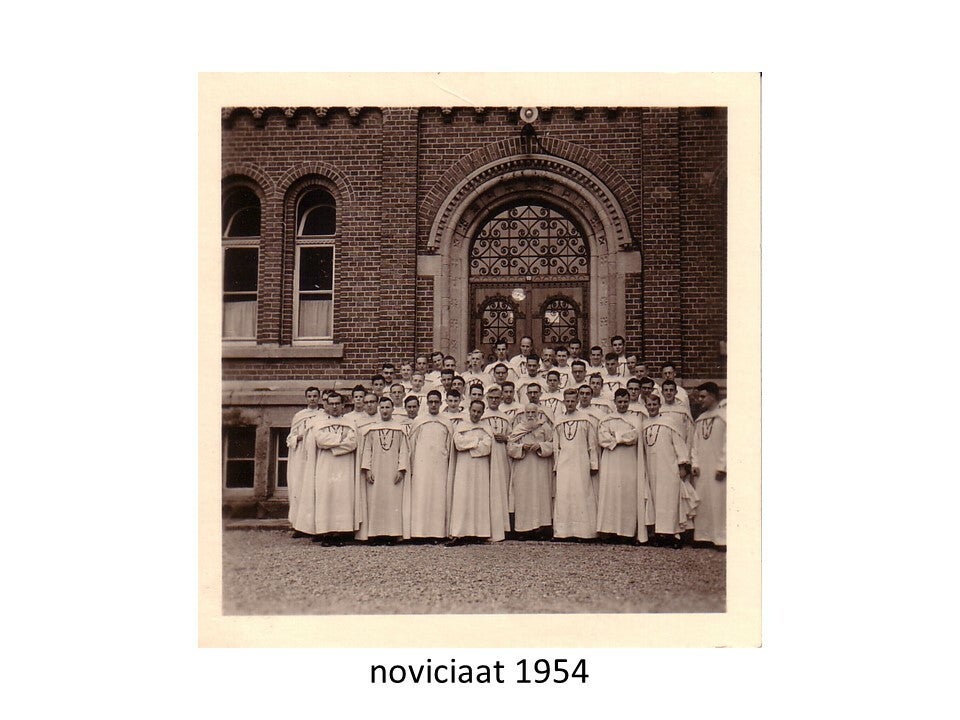
We, the Dutch formed the majority but a good number came from abroad, from Great Britian, Ireland, Germany, and Spain. At the end of the day we were complete: a lively group of 42 young men.
I had a [premonition that the year 1953-1954 was going to be a very interesting one.
There were not less than twelve students from ‘The British Province’. Brian Garvey, Frank Nolan, Gerald Corcoran, John Morrisey, and John Sandom came from England to be joined by Lionel Kearney a week later. Pat Menzies, Norman O’Connell, Bobbie Clyde and Alic McGarry came from Scotland. Eugene Lewis came from the Republic and Tom Bradley from the North of Ireland. They seemed outgoing people, but a bit lost in such strange surroundings. Some of them spoke in a strongly local accent and I had difficulties to understand them. A day later two Germans arrived, Heinrich Eich and Karl Grammelspacher. Both of them had been recruited at the end of the war as ‘child soldiers’ in order to dig trenches for Hitler’s retreating armies. Heiny showed us pictures of a little boy, dressed in an oversized trench coat and a shovel in his hand. He smoked cheap cigarettes and was quickly told by the welcoming novice master to get rid of them if he wanted to stay. There was Aloys Reiles from Luxembourg who later taught us Christmas Carols in his language.
What can I write about that one year of Novitiate in the rural Achterhoek (backcorner) of Gelderland?
I remember it as a time of spiritual enjoyment. It was supposed to be a probation year during which we were to be tested on our mental and spiritual strength. But after the rigours of the war and the hard work during the days of the junior seminary, the Novitiate was for me a year of peace and rest. I still regard it as one of those presents that the Roman Catholic Church has in store for those who enter its ranks.
The year was opened by an eight days retreat, all of us in silence, directed in English by the Dutch Novice Master, Kees Vanden Bosch. It ended with a simple but moving ‘investment’ ceremony during which we all received the habit of the White Fathers.
It look somewhat incongruous, those young men dressed in an Arab attire. I had also to get used to have a ‘skirt’ around my ankles and wondered whether I would have to go through life dressed like that.
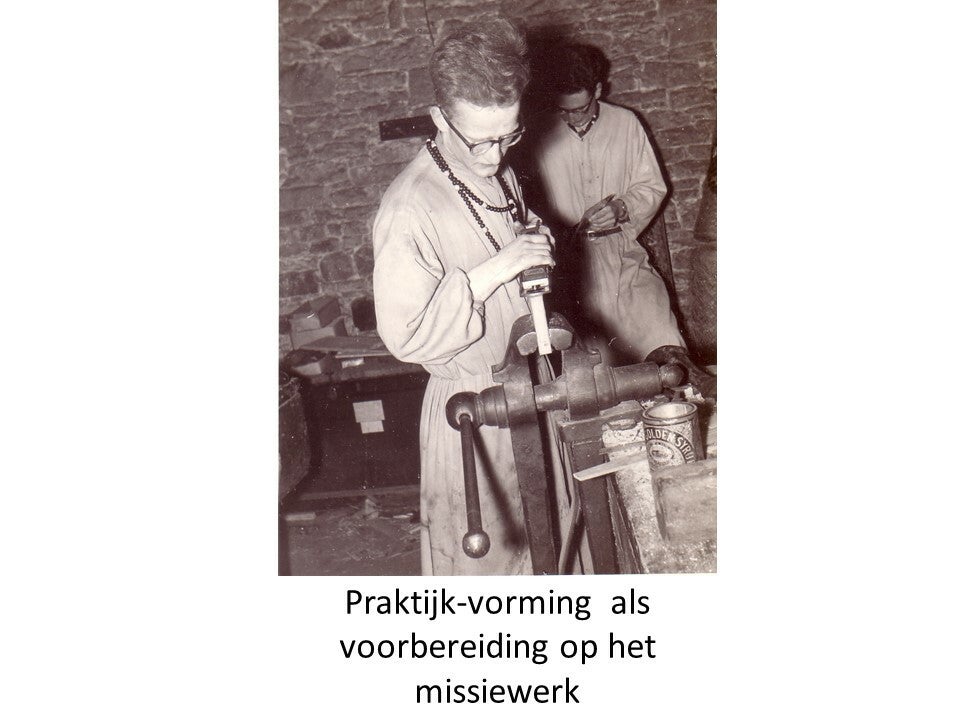
We were also given a rough, khaki ‘working’ habit for the many hours of manual labour. The novice master told us that, according to the rule, each White Father Missionary had to spent a minimum of two hours a day ‘using his hands’. It meant that, as novices, it was our task to keep the house clean including the part where our ‘confreres’ next door, those studying theology, lived.
Through the village ran a little train rail that ended in front of our building, just before the border with Germany. In September a smoking locomotive pushed a number of small wagons filled with coal until the end of the line. We were told to shovel its contents into the cellar of our monastery near the huge boilers that heated the building. It was heavy work but we took our time and actually enjoyed and were proud of it.
This was followed by picking apples and pears from the expansive orchards behind the house and laying them out on the wooden shelves, down in the dark cellar. This basement was part of the solid foundations and ran beneath the entire building. There was a big cold room, storage places for potatoes, vegetables and other edibles. It even had a small cargo lift that could be hauled up to the kitchen, and from there to the two higher floors and the loft. Next to work in the grounds the novice master made us also scrub all the marble floors and clean the windows.
But it was not only manual work that kept us busy. We learned to spend four hours a day in public and private prayer, mediation, and other spiritual exercises. The White Fathers’ spirituality was ‘Ignatian’ with the motto Contemplatio in actionem tradere, to translate one’s contemplation into action.
Later in Africa, with its permanent demand for manual work, the temptation to stress action more than any contemplation remained always very great.
We were introduced to the life of our founder, the Frenchman Cardinal Lavigerie. Our dear novice master told us with a tinge of sadness that his canonization would never be on the Vatican’s agenda as he had been an enfant terrible for the members of the Curia in Rome. At that time I did not really understand what he meant and stored this piece of information away for later scrutiny. Much later I discovered that this Cardinal had been years ahead of his time as he realized that the Catholic Church would have to burst out if its narrow Roman straightjacket in order to be properly rooted in the soil of Africa[8].
The first signs of, and demand for, genuine change was already in the air around that time in 1953. It came, not from the staff, but from the students. In October we heard that a first year scholastic, called Adrian Hastings, had decided to join the local clergy in Africa in order to serve as a diocesan priest. Later others followed him. Their aim was a total identification with the continent of Africa. At the beginning of 1974 he was accepted by the diocese of Makasa in Uganda and went to Rome to finish his studies[9].
This move made all of us think.
Other ideals that attracted us were the commitment of the ‘worker-priests’ in France and the life of Charles de Foucauld in the Sahara. Some seminarians of our generation would eventually join them either before or after their priestly ordination.
English was the language in which we communicated with each other, even with my fellow Dutchmen. I had no difficulty with that whatsoever. As has been seen, the war and the liberation by the Allied Armies in 1945 had made me an anglophile. Moreover, for the unification of Europe, would the English language not become the lingua franca of the future?
I was not to become sidetracked during my studies, remained single-minded and learnt as much as possible about the background of Great Britain. My British fellow students, some with a number of A levels, were always ready to teach and to correct[10].
For the novice master Kees VandeBosch we were the second and also a very big group. His spirituality was rather simple: one had to follow the will of God at all times and the will of God was to be found in one’s superiors.
This reminded us, products of the war, too much of the German army maxim: ‘Befehl ist befehl’, that had caused such misery during the war and we loudly objected. It caused a permanent tension between him and us. We decided to settle down, take his lectures with a grain of salt and o leave things to the future.
A Spaniard, whose name I have forgotten, looked very puzzled when we, the Dutch, told him a few days before the 5th of December that being a Spaniard, he had to become Saint Nicolaas. It took a great deal of explaining but he was so kind as to comply with our wishes. That very day, still dressed as a saintly bishop he told us that, like Saint Nicolaas, he had decided to go back to Spain and left us on the next morning.
Our novice master had a rather negative view of the sinful world and a somewhat outdated disdain for ‘the felsh’[11]. During Lent, a period of daily fasts and abstinence, he even encouraged us to wear spiked bracelets around our arms. “in order to suffer with Christ”. One of the British novices, John Sandom, a late vocation, objected openly against this and adamantly refused to accept anything of it. Before joining he had served his country as a medical orderly in the Royal Air Force.
“During my training they taught me always to preserve and cherish life” he said loudly, ‘I will not accept anything that harms people’s health, especially the health of young men who are being prepared for a hard life in Africa”.
The novice master was wise enough to smile and leave it at that.
That Lenten period was indeed a tough time. One of the Dutchmen, a Friesian, called Jaitze DeRee, became dizzy during morning physical exercises and collapsed. He was judged not to be strong enough for the wilds of Africa’ and was asked to go home.
One of the Scottish students, Patrick Menzies, became ill and was diagnosed to have the beginning of a stomach ulcer. He had to take a long rest and to follow a special diet. As the person in charge of the infirmary, it was my task to look after him. Oblivious of his existence it happened several times that I forgot entirely to bring him his light meal. Long after his recovery he claimed that I had starved him to death. Once recovered he taught me how to cut the hair of my fellow novices.
“As long as you do not see an ear rolling down the sheet, “ he said laconically, ‘ you are doing fine”.
We were a large and surely not an easy group that took things without any objection. As a matter of fact a month before the end of that year, our dear novice master became overstrained, and went for a rest, only to return a week before the end, to say goodbye. Discipline became relaxed under an easy going socius, a young missionary just back from his first stint in Uganda. During that time our nestor and amateur painter, Theo Winkelman, took his palette and paintbrushes out of his suitcase and asked each of us to sit for a few sessions in order to make a portrait.
That year will always remind me of the scent of drying apples and pears opn the shelves, the dust of coal in the basement, learning to speak English properly and reading ‘David Copperfield’ during a long spring and an early summer.
All by all it had been a wonderful year. Whether we learned to be obedient novices was another question.
Scholasticate in ’s-Heerenberg 1954 - 1957
We were finally ready for the last sprint towards our final oath and ordination.
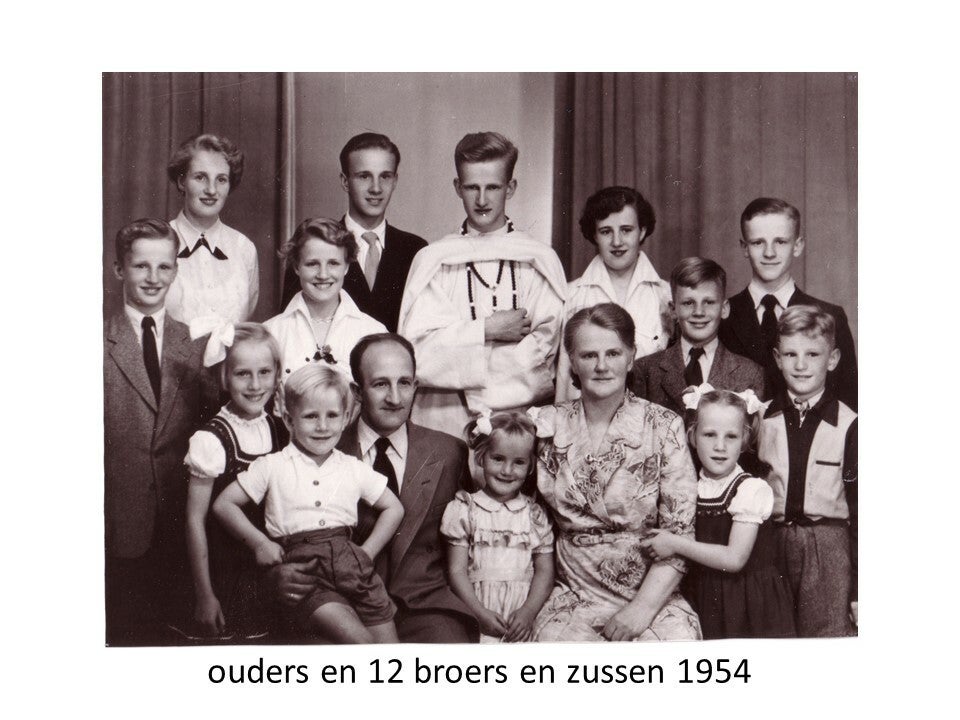
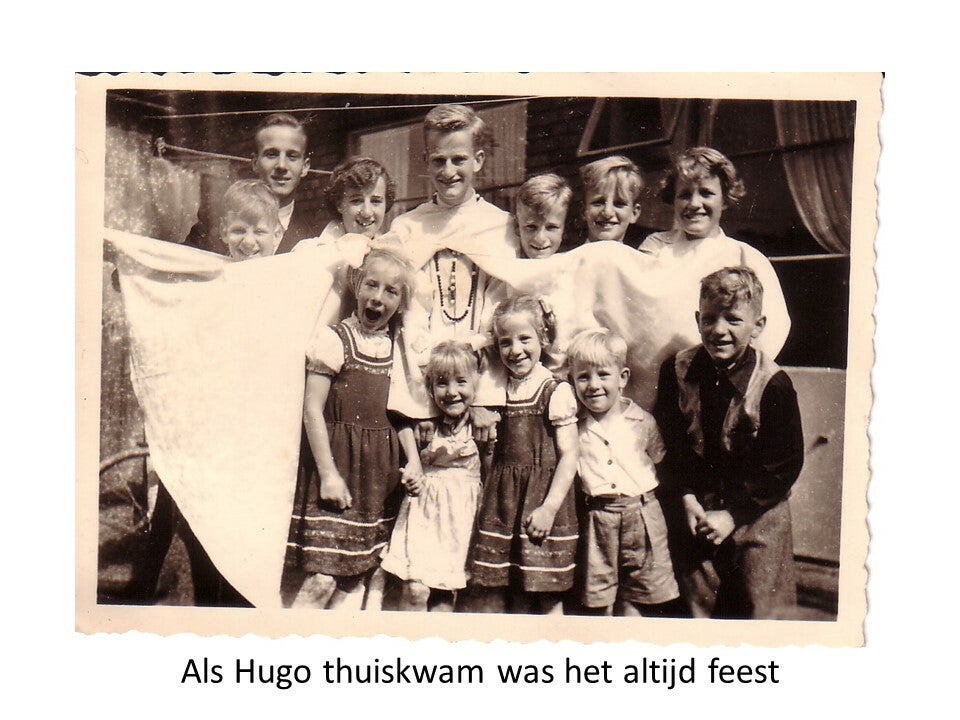
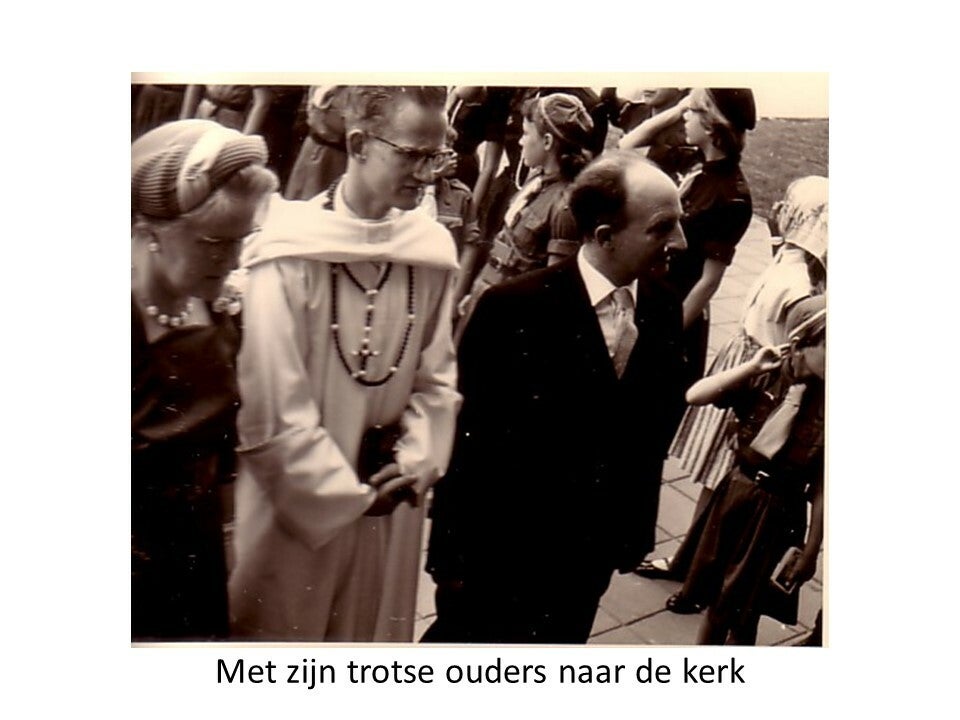
We, the Dutch, were permitted to go home at the end of August and were told to be back in the second week of September. I was not allowed to go a bit earlier to celebrate the 25th Wedding Anniversary of my parents on the 14th of August. During my short stay in de Kokosnootstraat a picture was taken of the entire family, all thirteen of us, children with our proud parents who asked me to wear the white gandourah and burnous..
At home the foundations of a new parish church, dedicated to St Paul, had dug and on the 29th of August 1954 the first stone was laid and blessed by the bishop of Haarlem, J.P. Huibers , assisted by the parish priest, N. Molenaar and his curate, J. Brans.
The latter was a very popular figure in the parish, beloved because of his excellent sermons and his devotion to the youth. I remember that after the ceremony I talked with him about the future. According to him the establishment of the St Paul’s parish, independent from the one in Loosduinen had come too late.
“Within a decade all the young people of the catholic families over here will be married and will have moved somewhere else” he prophesied. He proved to be right.
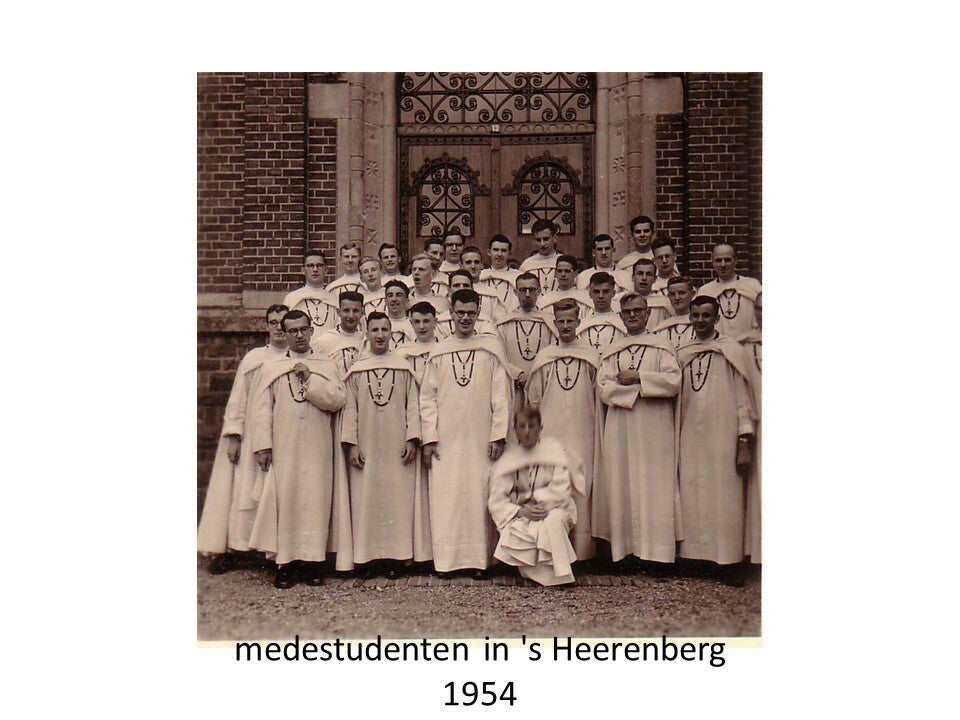
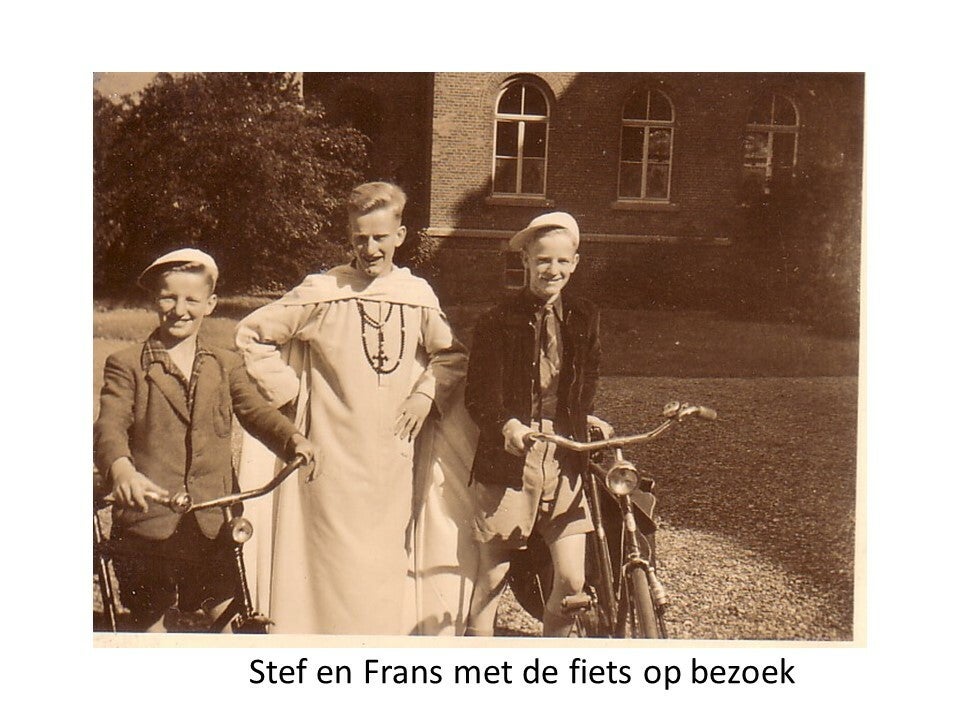
I cycled all the way back from The Hague to s’Heerenberg, not only to save money but this time to have my own bike nearby for trips in and around the place as there would be no holidays home for two consecutive years. Our group became even more ‘internationalized’ by the arrival of candidates from Canada, France and Belgium. Some of my Dutch classmates were sent to the houses of study, the Scholasticates, abroad[12]. The leadership of the White Fathers was seriously intent on making their society as international as possible.
However, to be in an English speaking place of learning on the very border of Germany and The Netherlands was rather incongruous, to say the least. It caused us to be cut off and isolated from the population nearby and from ‘the world at large’. It made the place very inward looking, intellectually not very exciting. We had no contact with other theological colleges, let alone places of culture or interest in The Netherlands or Germany. And this in a time when the Catholic Church was slowly waking up from its antiquated slumber and produced brilliant theologians who would contribute so much to the success ofthe Second Vatican Council in the first half of the 1960s.
Was this done on purpose? Were we still being prepared for Plantare Ecclesiam, the planting of the Roman Institution of the Catholic Church in the young countries of Africa?
The studies were indeed based on Pope Leo XIII’s and Cardinal Lavigerie’s rather rustic vision of a Catholic Empire to be founded in Africa. The study of philosophy was not regarded as an independent inquiry but seen as a preparation for the study of systematic Theology, based on the teaching of the medieval theologian, Thomas of Aquinas[13]. He taught that each person, created in the image of God, had a natural law imprinted on his or her mind which was accessible to reason, but that this natural law could only be enlightened by the teaching of the Roman Catholic Church. The Moral Theology that was taught during those 4 years was obviously meant for the needs of an upcoming middle class of European Catholics, emancipated since the beginning of the century.
Finally the lessons on Spirituality were permeated by the teaching of Jansenius, a very narrow and over scrupulous Flemish bishop of the 16th century. His teaching had been condemned but reappeared in the seminaries at the beginning of the 20th century[14]. As has been seen, the Catholic Church aimed at the firm establishment of its structures amidst a hostile world. It resulted in the founding of a host of populist social institutions and even political parties.
To say the least, the lectures of the White Fathers in Theology were confusing to us, products of World War II at least to me. It was said that our founder, Cardinal Lavigerie had been open to the wider world and had accepted, even ‘toasted’ the progress that had been made by the world since the French revolution.
But our lecturers, most of whom had not as yet been in Africa, kept faithfully and obediently to a very narrow and inward-looking mind-set of Rome’s worldview who identified the biblical Kingdom of God with the glorious and triumphant establishment of the Catholic Church on earth.
The model was based, not upon social equality but upon a harmony in which unequal classes in a very traditional hierarchy exercise so called Christian charity and forbearance towards one another.
The more intelligent and outspoken students among us had their objections and made some of the lessons rather lively, if not riotous.
It was an Irishman, Fr Chris O’Doherty, who made us sit up and be alert. He lectured enthusiastically on the Social Teaching of the Church and sprinkled it with a whiff of Celtic Theology. With him we studied the encyclicals ‘Rerum Novarum’ of 1891 and the one published 40 years afterwards : Quadragesimo Anno. He caused the real world to enter in our classroom of which a number of students were of the same age or even older than he was.
Much later, during an interview, not long before his death, the Superior Fr Emile Geurts, agreed to the incongruity of the situation[15].
“I found myself, after nine years in the bush of Africa and just 34 years old, in charge of some 160 men of whom a great number had been in the war and were older than me.” he admitted
Indeed, some of British had taken part in D Day, a number of the Germans had known the misery of a retreating army and had been prisoners of War, some Frenchmen had been members of the ‘Free French’, others were serving in Algiers[16]. Most probably they were still traumatized by what they had experienced but never spoke about it until late in life. Sometimes we, younger students, were given glimpses of their past. During the ceremony of the Diaconate a German confrere hesitated to take the perpetual oath of the White Fathers. “I killed to many people”, he groaned. He had to be encouraged to take this important step in the sacristy by one of our German lecturers who himself had served as an officer in Italy.
An ex-pilot of the RAF re-lived the bombing of Dresden in Germany while ex soldiers, like Tom McKenna and Jimmy Hughes told us about the events of D.Day. Jimmy had been hit by a bullet in his back and was impaired for the rest of his life. He later joined the Jesuits and died in Harare, Zimbabwe. The German John Faulhaber retreated from France after D. Day, got separated from his unit and finally gave himself up to the Allied soldiers[17]. I realized that their visible trauma was only a tip of the iceberg and that most of them left for Africa with burdens of the past.
It must have been very difficult for them to attend these dry and out-of touch lectures of the Roman trained teachers. Most of us were determined to ‘get through these years’ in view of ordination and work in Africa. Some of the bright students however, like Joseph Donders, acquired modern journals of theology, and by their questions and replies instigated a lively debate in the class room. Change was on the threshold of seminary life but was not welcomed, or allowed to come in as yet. This caused a constant tension between the staff and the students.
The first year passed without any interesting events. Without any contact with the outer world we learned to spend our free time in and around the grounds mostly by sport and long walks to the villages in the surroundings. Most of the British were avid sportsmen who in all seasons organized football matches, volley ball games, and athletics of all kinds. My classmates Pat Menzies, Johnnie Morrisey ,Alec McGarry and Eugene Lewis, usually well behaved and kind men, became fanatic and, according to us, rough and mean once on the football pitch. They came to win and not just to play and were not afraid to give the opponent a foul push and then reason with the referee that they were innocent. I remember long afternoons of football in the gray mist and dark mud of the flood plains along the Rhine, to come back exhilarated and ready for more study.
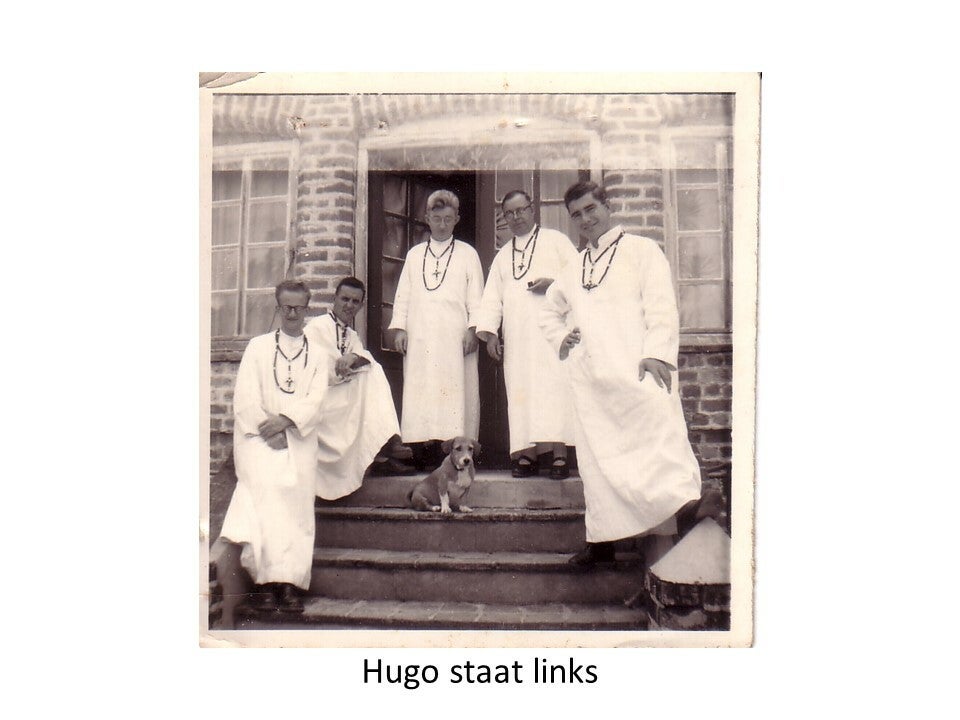
At that time the White Fathers had no special house for the elderly. Most of them died young ‘in the missions’ but those who survived and came back were accommodated and cared for in the houses of formation. We had to look after them and also to keep the wake before and after their death.
One, a rather cantankerous old man was Fr. Willem Binkhorst, ‘Binkie’ for short. He came from Rotterdam. He was mostly bed-ridden but insisted on celebrating the Mass in the early morning. We had to serve him but, according to him, never did it properly. We feared and at the same time joked about him, imitated the way he shouted at us and, behind his back, sung the Dutch sea shanty Ketelbinkie[18].
Father Binkhorst died in 1955 after a long and painful sickbed and long hours of care and waking. It was our duty to lower his coffin in the grave on a sunny day in May. We had no experience, let the ropes slip and dropped the coffin in the grave with a loud bang!
In our imagination we heard him shouting from within his cask:
“You, bastards, you cannot even bury me properly”.
That day we sang our version of the famous Negro spiritual:
“Were you there, when they dropped him in the grave, in the grave
Oho, oho, sometimes he causes us to tremble, tremble
Were you there when they dropped him in the grave”[19].
After my lessons, given by Pat Menzies, I was appointed to become part of the team of haircutters and tonsure shavers. There was always a waiting list as it was done during our free time. The state of the art was to manage to do four men in an hour but I never reached it. We consoled us with the thought that the difference between a bad and a good haircut was only two weeks.
After the first year the students received their tonsure. It was a rite by which a layperson became a cleric made visible by an outward sign, namely a round, shaven space at the crown of the head. This space had to be shaven regularly if not weekly. We pressed a square piece of metal with a round hole in it on top of the victim’s head, soaped it and shaved the open space. Some of my confreres, in particular the French, had strong, vigourous black hair that not only blunted our razors but also cut their skin!
The tonsure also prepared the cleric for the minor and major orders. The minor orders were those of the doorkeeper, the lector, the exorcist and the acolyte, while the major orders consisted of the sub-diaconate, the diaconate and finally the priesthood. During those endless three years I received and underwent these quaint rituals as part of long, obstacle race to the final oath, the ordination and the appointment to Africa.
As I said, I was ready to do anything required in order to reach that end.
There were no ‘holidays home’ in the summer of 1955. In stead a coach took us to a place, called Schöningen near Roermond. There we were asked to do youth work, that is, to keep inner city children of Roermond busy and happily occupied. Some of my foreign classmates joined me and tried to learn a few words in Dutch. I had never difficulty in dealing with children and had gained plenty of experience from my youth work near The Hague. I loved the children with their soft Limburgs’ accent, their innate politeness and exuberance. The place had a shallow pond where they could play to their hearts content until late in the afternoon. After three weeks of youth work we were given a great time, camped in an old hut and prepared our own food. Fr Emile Geurts, our superior who originated from Limburg, seemed to come in his own and was a completely different person as he was during term time.
The second year theology was, academically speaking, as dull as the first, if not duller. Moreover it was a very cold winter. Everything, the floodwaters of the nearby Rhine, and the ditches in the garden froze. The moat around the castle of the Manor house, originally owned by the Duke of Gelre became a perfect skating link. During free time the Dutch reached out for their simple skates and the French and the Canadians came with their ice-hockey skates and sticks. The latter organized an exhibition match for the benefit of the people in the village who came in big numbers to look, especially the youth.
However the relatively small boilers, down in the basement, failed to keep us warm. An icy wind blew for weeks through the cracks of the old windows. I remember sitting on top of the outdated central heating with a book in my hand trying to learn a bit of theology. The subject was ‘Christology’ and the ‘Trinity’. It meant trying to follow the minute discussions of old and forgotten medieval monks who wondered how many Angels could sit on top of a needle! All this depressed me. “What on earth has this to do with proclaiming the good tidings of Jesus Christ to the people of Africa?” I asked myself.
I was never at my best in the early morning and tended to feel asleep, not only during the meditation but even during the first systematic and moral theology lessons. When this was followed by a class on Canon Law and a session on the rules and regulations of Liturgy, the day passed very dismally indeed.
It was then that some of my friends left. First Oscar Holleman, who had been my mate since 1945. He was followed by Lionel Kearney who had joined us in the Novitiate[20].
Another student, Norman O’Conner, followed. He was artistic and could draw funny strips and caricatures. The authorities in the central Generalate in Rome decided one day to pay more attention to the life, the visions and the writings of our founder, Cardinal Lavigerie. Each year one day was earmarked for this purpose and called “Cardinal’s Day.” He had been in favour of the French Revolution and had toasted the French Republic It happened during a meal to which he had invited all the army officers, stationed in Algiers who were known to be Monarchists.
This was quickly taken up by the French newspapers and one of them, Le Temps, praised it in its editorial as a first step towards reconciliation with the Catholic bishops. Lavigerie himself was severely criticized by France’s right wing of monarchists. He was even accused to plan a coup d’état[21].
We decided to stage a small exhibition on Cardinal’s Day and Norman was asked to make a few caricature drawings. To everybody’s hilarity he drew a piece of toast on the paper with the words Toast d”Alger under it ‘Algiers’ on it and a Friesian cow with the word ‘Coup d’etat’ on her belly[22].
Our rector, Fr Geurts was not pleased and told us to remove the cartoons as quickly as possible. For Norman this seemed to have been the straw that broke the camel’s back. He said goodbye to all of us and left that same day for Scotland.
Fortunately there were also highlights. At Easter, after the long ceremonies of the Holy Week, we were allowed to leave the place and to cycle all the way to the new junior seminary in Santpoort, near the coast, a trip of about 150 km. A small coach, called the broomwagon followed us to pick up those who failed to make the entire journey. For the ‘auslanders’, not all of them used to cycling, it was indeed a long journey.
After the severe and tedious life in s’Heerenberg, Santpoort was heaven. We were allowed to go all over the place as long as we were back in the evening before dark. My whole family, parents, sisters and brothers, came to visit me from The Hague. My father and the older children came by bike, cycled a 140 km, down while the young ones arrived by train with my mother.
I was always deeply moved when they walked up the drive to the house, young, healthy and smiling, with their future in front of them. It was a good time and already then my parents were proud of what they had achieved since their own, so difficult youth.
During the second year, in 1955, Fr Piet de Ruijter became the Dutch provincial. Born in 1914, and ordained during the war, he had been appointed to Chipata in N-Rhodesia (Zambia) in 1950[23]. During his first visit to s’Heerenberg he made it a point to see each Dutch student in person. I confided to him that I found the stay in the Scholasticate severe and that I wondered whether I would be able to sustain this way of life in the future. DeRuijter, a practical man who came straight from Africa, reassured me and said ;
” Push on. Africa is different. Once you are in the treadmill of mission work over there you will enjoy it !”
That kept me going. The series of talks on life in Africa by Fr. Geurts himself and the interesting stories of the White Fathers on leave were also a boost. I could never get enough of them. Another welcome feature was a stay of two weeks in Heverlé, the scholasticate of the White Fathers in Belgium. It was 1956 and the first glimmer of a drastic change in the Catholic Church made itself heard, especially among the theologians of France and Belgium. The students of that scholasticate were in touch with the latest articles and books of that time and seemed much more ‘up-to-date” than us. This did not lessen the tension that reigned the atmosphere of s’Heerenberg but it were signs of hope for a better, more open future.
Fr Geurts had come to the end of his stay as rector. He was tired, and looked forward to his return to sweet Tanzania
The new superior was Father Antoine Smits. He had been rector of the Major Seminary in Katigondo, Uganda and the life of a ‘formator’ seemed to come easily to him. He was more relaxed than his predecessor and to our joy we heard one good day the tones of a violin coming out of his room. In fact he encouraged artistic expression especially during holidays[24]. He enjoyed our social evenings, and possessed enough humour to accept our veiled criticisms and sly digs[25]. He encouraged us to study missiology and more ‘secular’ subjects like psychology and sociology. There was plenty of material in the library and reading room in these subjects and I spent many an happy hour getting acquainted with the labour disputes and the emerging nationalists movements of Central Africa.
We cycled to Kevelaer, a place of pilgrimage of Our Lady just over the German border where we became deeply impressed by the singing of the German pilgrims from various villages nearby. The country was working extremely hard to get over the destruction of the war. We went to admire the modern architecture of the new churches and public buildings, built in a period during which the people themselves still lived in the cellars of their bombed-out dwellings. There was progress and reconciliation in the air and we felt that, despite all harshness during these three years in s’Heerenberg, the White Fathers had made us international citizens of the future.
During the Easter holidays volunteers were asked to help with the building of a German novitiate in Hörstel I gave my name with enthusiasm but again over-estimated my physical strength. We were asked to transport liquid concrete in big wheelbarrows from the mixer and pour the contents into the foundations. I did rather well for three days but one good morning I slipped and fell exhausted into the concrete, almost the same way as I had fallen in the muddy ditch when working in the market gardens some years before.
The wise Chris O’Doherty decided that I done enough and gave me a lift back to s’Heerenberg during the following weekend[26]. He asked me to help him with laying the pipes for the drainage of our water-logged football pitch and we spent a pleasant week together[27].
That last year in s’Heerenberg we reached a part of Moral Theology called De Sexto, all about the rules concerning the sixth commandment. It was given by the superior, Father Antoine Smits and it became soon evident that he had been all his life in seminaries, in ‘houses of formation’ with little contact with the raw reality of the families in the parishes. He kept mostly to the moral teaching of ‘Noldin’, I let it all go over me like so many waves of useless study material and decided to see and judge myself, once being ‘in the field’.
In the beginning of August 1957 we had reached the beginning of the end. My application to Rome for the Diaconate was accepted and I received ‘the call of the Church’ It included also the call of the Society to make my perpetual oath. One fellow student was refused. He had been seen skating romantically with a young lady on the moat of the castle of ’s-Heerenberg until late in the evening and was asked to wait one year for further consideration.
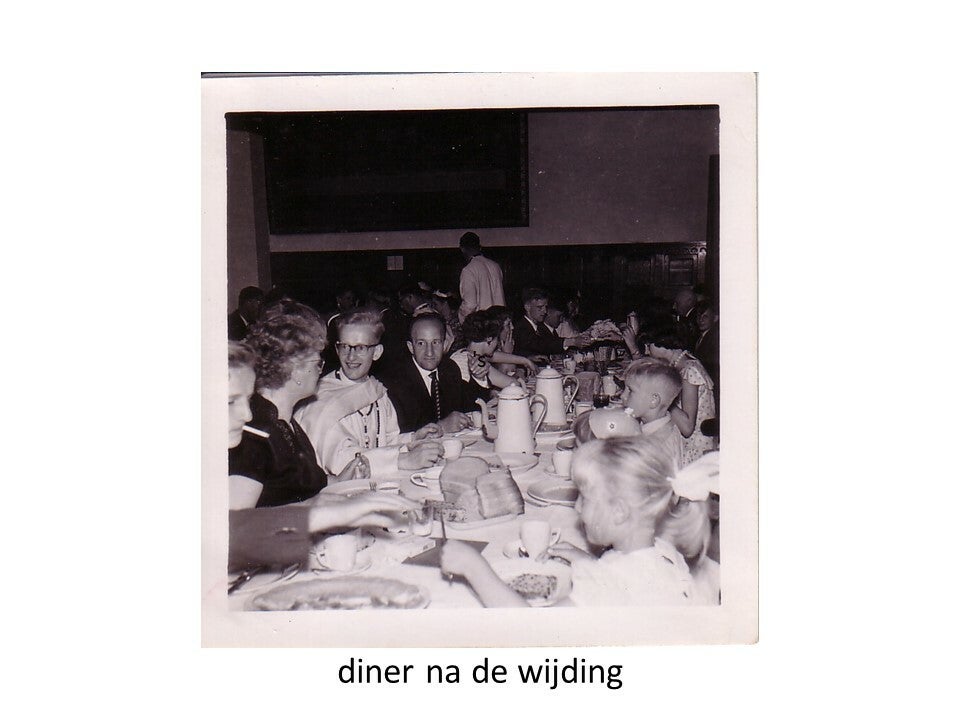
For my parents and for my brothers and sisters this remained for ever remembered as a very great and festive event. They hired a coach, and came with tents and camping equipment. My parents and the girls were accommodated by the family of my class mate, Jan Rademaker. They owned a shop and lived in a big house in s’Heerenberg itself. My brothers pitched their tents in the orchard near our small swimming pool and had a great time. It was a sunny, even hot day and they dived into the cool waters as soon as they had the opportunity. Unfortunately, according to the rules of the seminary, the pool was only for men and women were not allowed in. My sister Carla, then just seven years old found this very unfair and would never forget it.
The ceremony itself was drawn-out and for young people a bit tedious. Nelty, one of my young sisters, found it so long that she slipped out into the corridor and looked at the peaceful landscape outside. Somebody took a picture of her at that moment which she kept all her life.
I personally remember vividly the great moment of the oath, pronounced on the steps of the altar with the Bible in my hand. It expressed clearly for what I had come for, as a boy of twelve years:
To consecrate myself unto death to the mission of Christ in Africa
All other ceremonies have become distant, vague and now seem of minor importance. That oath to work for Africa would ever remain in my mind.
The Last Year in Monteviot, Scotland 1957 - 1958
In August we left for Great Britain, from the self-enclosed world of ’s-Heerenberg into a wider world. The British had gone before us, back home after having been away for four years. Later they to told us that on the ferry boat from the Hook of Holland to Harwich, they had exclaimed with relief :
‘Thank God, the days of dry sandwiches with horse meat are over!’[28].
We, the 12 Dutch and the Belgians, were told to travel from Liverpool Street Station to South Finchley in London, where we would be accommodated by the Jesuits and given a week’s introduction on ‘The British Background’. And true enough, the morning after our arrival, a spruce lady of the British Council was waiting for us, ushered us all into a minibus for a day of sight-seeing. I remember being taken to the Tower, where we were handed over to a Beefeater who must have been a Catholic. As a special privilege he took us straight to the place where St Thomas Moore had been condemned to death, narrated the latter’s life and kept a minute of silence. It was a moment never to forget. Later in life, when having to deal with Church and State relations, I would often think of this saint who gave his life for his principles.
The following days we were mostly taken to Anglican churches, in one of which we were given a small lecture on ‘the Anglican tradition of literature, of learning and the tolerance of English life.’ The rector told us that his Church was always ready to borrow from the doctrine, the devotion and scholarship of the wider Catholic world. He personally had made a visit to Africa where he had witnessed how the ‘mainline’ churches worked together for the benefit of the natives.
We also visited the “Africa Centre’ where we learned about the hierarchy of the Colonial Administration. At the same time we met and talked with a group of West Africans who made us aware that the end of the British Administration was in sight. Finally the hard working lady took us the Lower Court of Southamption where we followed the cases of that day and where introduced to the English Judiciary System, ‘where nobody is guilty until proven’
That Saturday my classmate, Brian Garvey, phoned me, introduced me to his parents and then guided me, first to a cricket match at The Oval and then to a football match on the Chelsea grounds near Stamford Bridge. From then onwards I became a Chelsea supporter.
It had been a hard but very rewarding week. The accommodation by the Jesuits did not include lunch, so during the day we had to fend for ourselves. I lived mostly on ‘fish and chips’ as I did not know what else to order that was cheap. The British pound was strong, 10 florins for one pound and our little pocket money was quickly finished. But after the controlled life of the Scholasticate, the experience of a free life in London was terrific and very liberating.
To assimilate all the information we had received we were given week of rest in the White Fathers house of Philosophy, called Broome Hall, situated in Dorking, not far from Gatwick. The place, an old manor house on extensive grounds, pleasant gardens and with a wide pond, used for swimming and boating, was a little paradise[29]. The week passed like a dream. I remember seeing for the first time those little Jersey cows in the meadows and thought they were deer. I helped the gardener in his Victorian green houses, which looked like the green houses of the Westland but were built against red bricked walls.
One of the workers took me to a big concrete plateau, behind the house. ‘Here is where the Canadian tanks were stationed before they took part in D-Day’ he said soberly. It made me think of that gruesome war, the sacrifices of so many young men and our longing to be liberated.
All by all we had a great time. It seemed as if the White Fathers repented for the harsh time they had given in s’Heerenberg. Or were they more forthcoming, now that we belonged to their Society for life?
The day came when we had to leave for the high North in Scotland. We boarded the night train for Edinburgh in London, were shown our births, and looked around until we were pulled out of gray London. I felt almost immediately into a deep and long sleep, slept all night and was woken up by Theo Winkelman , pulling my arm and shouting :” Wake up. Wake up, Look how beautiful” We were gliding through magnificent hills and mountains of the Scottish Borders, and were approaching Galashiels where we had to alight. There a jolly looking White Father who was the bursar introduced himself as ‘Gaf’, and got us in his old bus. Before we knew we were on our way to a place called Monteviot[30].
And what a place it was. After a drive down hill a castle became suddenly visible, near a silvery river called the Cheviot. It consisted of a central core home with on both side a host of rambling appendices, little towers, turrets and conservatories. A well-trimmed lawn swept down the hill towards the river via a series of terraces. Further on there was a suspension footbridge that connected one side with the other.
We were told that this establishment belonged to Lord Lothian of Acrum, a noble ‘recusant’ family that had remained catholic during the Reformation. He was still young and after the death of his father he had decided to live with his wife and young children in the more amenable house nearby. He rented the ancestral home to the White Fathers for a nominal sum on the condition that they would keep everything, including the grounds, in good order. The castle also housed the novitiate for the British brothers. They spent most of their probation time mowing the lawns, gardening, and keeping the houses in good repair[31]. The castle looked big and extensive but inside there seem to be quite a waste of space with halls, little tower rooms, steps and staircases, and hidden passages all over the place. In fact we had to share the rooms that were originally meant for the servants. The lecture hall was in the well-stocked library with complete works of authors like Robbie Burns, Shakespeare, Keats and Shelley.
On the doorsteps of the castle we saw a small figure that seemed to come out of one of Dickens’s novels. He was our superior, a Dutchman, called Fr Theo Moorman. He had been in charge of training young men for the priesthood for many years and it was obvious that he knew the tricks of the trade[32]. We all got a key in our hands and were shown our rooms.
We spent the first days exploring the surroundings and met the shepherds herding their sheep and cattle nearby. I could hardly understand their accent but spent hours looking at the way they directed their herds with the help of a team of ever active border-collies. Some of these collies had become slightly deaf due to the kicks of the cattle. They did not always hear the shepherd’s whistle but the latter was so fond of them that he kept them as long as possible.
On top of one of the hills a former owner had built a high tower, dedicated to the battle of Waterloo! Along a small staircase one could reach the top and have a magnificent view of the rolling hills of the Borders.
The old servants, men whose fathers, even their grandfathers had worked on the estate told us with humour that in the past very often a new building, a tower or other projects was added to the house itself “after the gentlemen had enjoyed a good diner, a cigar and plenty to drink!”
Later we found a stack of old bicycles in one of the sheds that had been left behind by the group of deacons before us. We repaired them quickly and were on the way to all the glistening lochs nearby.
Our superior, Theo Moorman, was an of those ‘formators’ who himself had never been in Africa, and had always lived within the confines of a monastic formation house. He had a reputation of being strict, exacting, even finicky. He was addicted to always being on time and insisted that we follow his example.
Soon after our arrival Lord Lothian, and his two little children, came to greet us with a big and welcoming smile. Fr. Moorman introduced him solemnly to us with the following words:
‘And here, dear deacons, is Our Lord, the owner of Monteviot’.
We asked the Lord of the Manor him why the British kept to the left of the road and his explanation was that marching soldiers had their lance in the right hand and could easily defend themselves when they were attacked from an ambush coming from the left. He bade us welcome, invited us to enjoy the property and wished us a good year.
Our class was lucky as we happened to be his last year in the scholasticate’. He had become mellow, wanted to leave a good impression and enjoy a relaxed atmosphere. And that is what we got, all through the year. As an abstemious man he had never spent much of his personal money and decided that some of it was going to be spent on us during that year. During the Christmas holidays he took us to Edinburgh for a performance of the Messiah. During the long Easter recess he organised a series of outings that, according to him, would add to our knowledge of our ‘British Background’. I remember attending a court session of a then notorious criminal who was accused of a series of murders.
When the whole group became ill with a pernicious flue he cared for us like a father. He taught us the history of the Society of the White Fathers with humour and with all the warts and wrinkles of the founding fathers..
The main lecturer of that year was ‘Jimmy’ Smith, a lanky, no-nonsense, Englishman who took us through the finesse of Pastoral Moral Theology without much ado. With his degree and practical experience of life in Uganda as bush missionary and as vicar general he imbued in us a liberal approach that had remained with me all my life.
“People will come to you in great trust” he said “and you are there to love and help
them.
Do not make life for them more difficult than it already is.
The Church teaches high standards of morality but at the same time accepts that
exceptions confirm the rule”.
He taught us to make a distinction between in foro interno and in foro externo. Publicly we hold on to the rules but at times and with the judgment of professionals like doctors decisions have to be taken that are not according to the general rule. There was the principle of double effect, when a lesser evil had to be preferred to a higher evil. In last resort the final moral decision was always in the hands of the well-informed consciences of the parties concerned. Finally he reminded us of Cardinal Lavigerie’s dictum that said that we are to carry the people ‘de chute en chute’ from one fall to another.
Jimmy Smith was an excellent and liberating teacher, who loved to play golf. At several occasions I found him practicing in his large room.
Another teacher was the Dutchman Jan Bessem. He was appointed to Monteviot in 1957 straight after his studies in Biblical Exegesis and was not much older than most of us[33]. His predecessor had been Fr Theo Van Asten who had gone back to Uganda and had left an excellent reputation. Even Father Moorman told me that Theo had been one of his best collaborators.
‘Bessempie’ as Fr Bessem was nicknamed was a modern teacher. He usually came into the class with a pile of books to read, divided us in small workshops and helped us to make good summaries of his lively lessons. This was a great difference to the ‘banking’, ‘the chalk and blackboard’ method of our former teachers.
The first term passed very quickly but the time after Christmas seemed endless. Spring and summer came very late in Scotland and the growing season was extremely short. We made long walks through the hills of the nearby Eildons, and loved to climb to the tops in poor and very cold weather. We roamed around, prepared our lunch and made a warm cup of tea behind the stone fences, protected from the icy wind.
One day our group consisted only of Dutchmen. We had left our bikes at the foot of the hills and walked into the endless space. A snow storm and a watery mist caused us to loose our bearings. Things became worse when we disagreed on what direction to take to retrace our bikes. Finally we found a path and decided to follow it to reach human habitation. We walked for hours, only to meet dismal cattle and forlorn sheep. Suddenly, out of the fog arose a dark and steady figure, a shepherd who looked at us with surprise.
“Where do you come from?” he asked.
After we had told our story he laughed and said :
“Do you know that you are in England, the other side of the Cheviot Hills?”
He got one of his sons to look after the cattle and sheep, and drove us back into Scotland with his small tractor. He refused any money and drove back into the dark evening with a roar. We soon found our bikes. They were still there, untouched, standing against the barbed wire, covered with the wool of the sheep. We arrived back in the grounds of the castle several hours after dark. The anxious Fr Moorman was on the point of calling the police for a search. From then onwards we were never allowed to venture into the hills without the presence of one of our British confreres[34].
When, later in life, I had to read and preach about the Good Shepherd, the steady figure of that shepherd, standing in the cold mist, ready to be of service, always comes to my mind.
Our group was too small to form double elevens for football. Moreover in the neigbouring villages and small town the men only played rugby. But on Sundays a group of young lads came to learn how to play football. This was regarded by their elders as ‘a lesson’ not ‘a game’, something that was forbidden by the Presbyterians.
We traveled to Hawick to see a few important rugby matches and enjoyed that typical raw and masculine atmosphere of the game and its supporters. We played basket and volley ball, walked and cycled to far away places all over the Scottish Borders.
In between we tried to prepare ourselves for the final examinations at the end of the year. When finally summer and a bit of warm weather came things moved quickly.
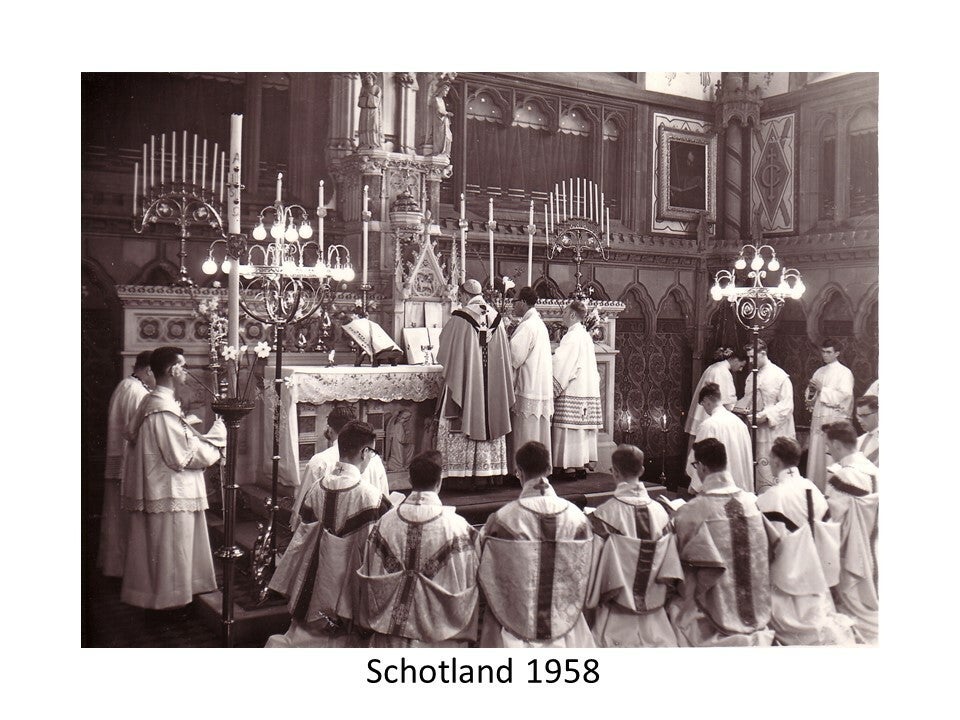
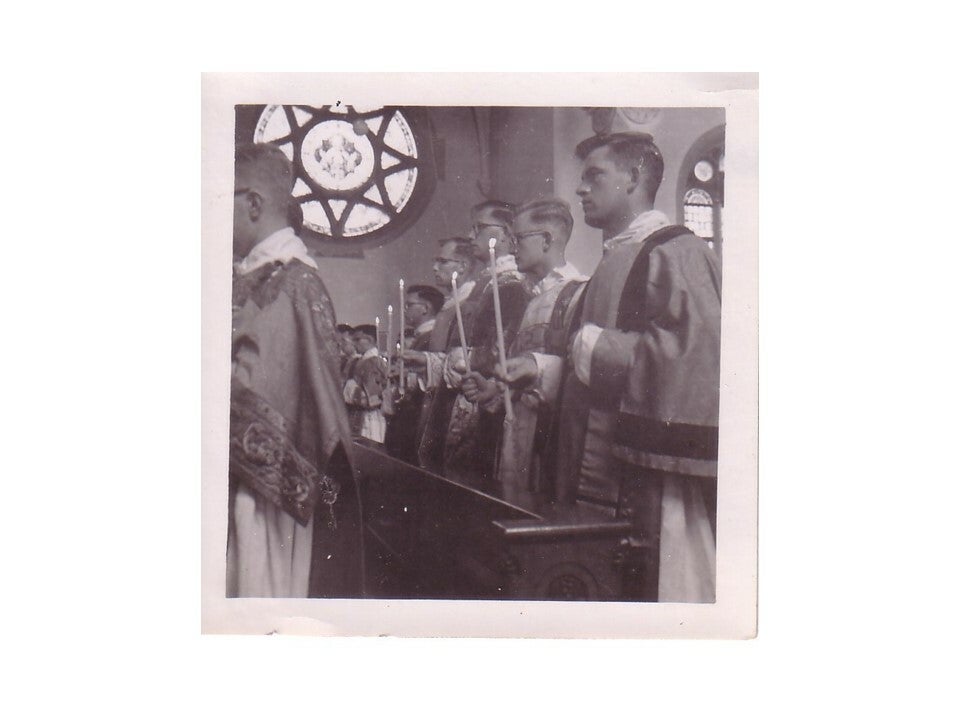
The first group to be ordained were the British, the Canadians, the Germans and the French They went to the parish church in Galashiels where the most Rev. Gordon Grey, Archbishop of Edinburgh ordained them[35]. I remember meeting the parents and sisters of Pat Menzies and two of the brothers of Brain Garvey who were secular priests and occupied important positions in the diocese of Westminster.
We, the Dutch would be ordained in July in s’Heerenberg, in the Netherlands to give our families an opportunity to attend. After a few free days studies we continued as before except that now we served the morning Masses of our confreres. Concelebration did not exist at that time.
And so we finally reached the end of our studies. I had started as a small boy of 12 years old and was now 25, still the youngest of the Dutch contingent. Pastorally Monteviot had been a very practical year but I also looked forward to step out of the hothouse atmosphere of all these training institutions, which I had managed to get through.
I wanted to return to reality, the same reality of life I had experienced during the War
A few weeks before the end of the academic year our appointment arrived from the White Fathers Generalate. As an average student, I was sure to be sent to a country in Africa, and not to be destined for more studies and teaching. I had volunteered to be sent to the diocese of Fort Rosebury (Mansa) in Northern Rhodesia.
The day of the appointment arrived. As youngest I came at the end of the list and I waited patiently. To my absolute horror I heard that I was appointed to teach in the junior seminary of Sterksel. I could not believe my ears and did not hide my utter disgust and disappointment. Was I to go back to where I had started in 1945?
I remember kneeling in front of my trunks and sadly painting the address of St Paul’s College, Sterksel on them. I wanted desperately to break out of the stronghold of seminary life. Until now I had patiently taken this restricted and often unreal life where ‘those in charge’ and a detailed time tables decided how to spend the day.
It was with a deep feeling of melancholy that at the beginning of July that I said farewell to that beautiful place along the river Cheviot in the Scottish Borders. Father Moorman had ordered a long distance coach that took us, Dutchmen, all the way to the night ferry in Harwich. From there we were to travel straight to s’Heerenberg by train. I do not remember much of that long journey except that we stopped in New Castle where in the restaurant I heard for the first time the voice of the South African singer, Miriam Makeba.
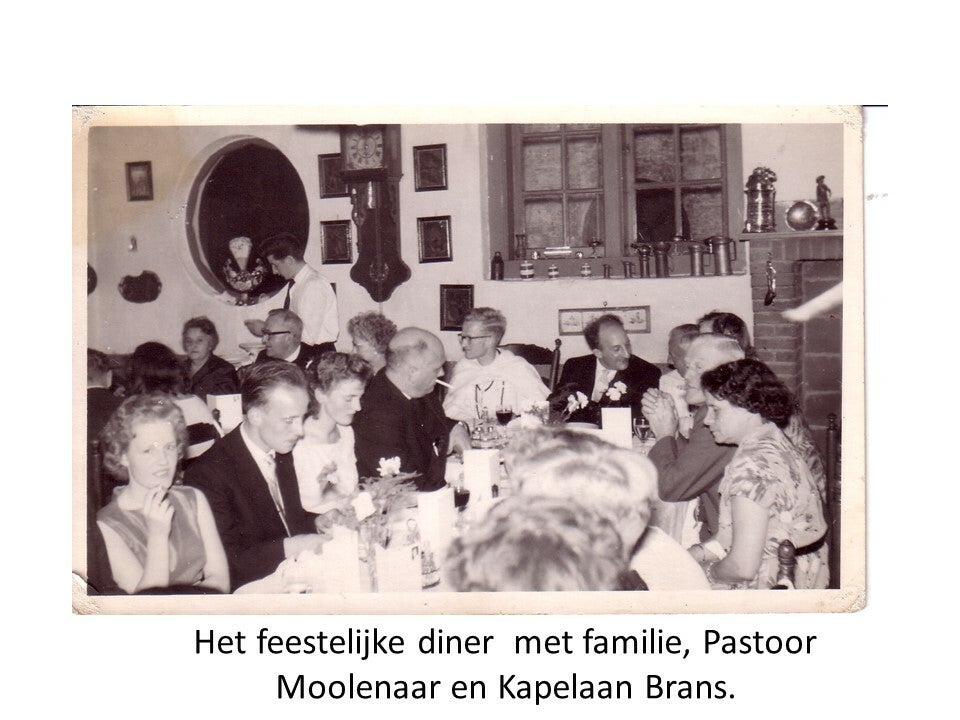
To prepare ourselves for the priestly ordination we went into another retreat. Meanwhile my family had again ordered a coach and arrived ‘en masse’ for another happy moment[36]. This time they were joined by the parish priest of our St Paul’s parish, Fr N. Molenaar and even a few elderly cousins of my mother from Oudewater.
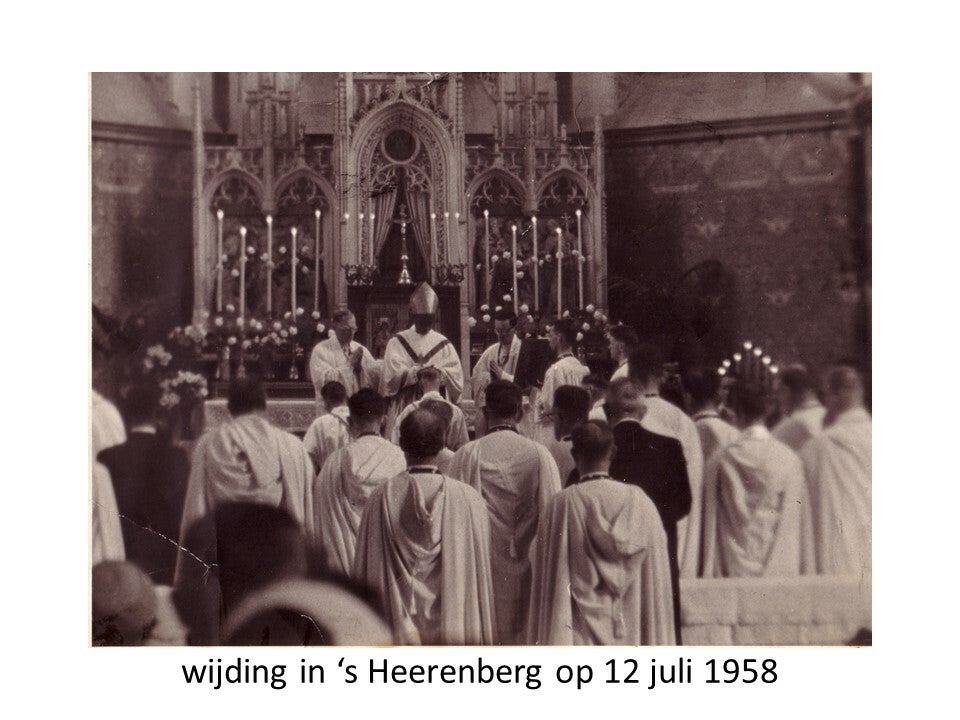
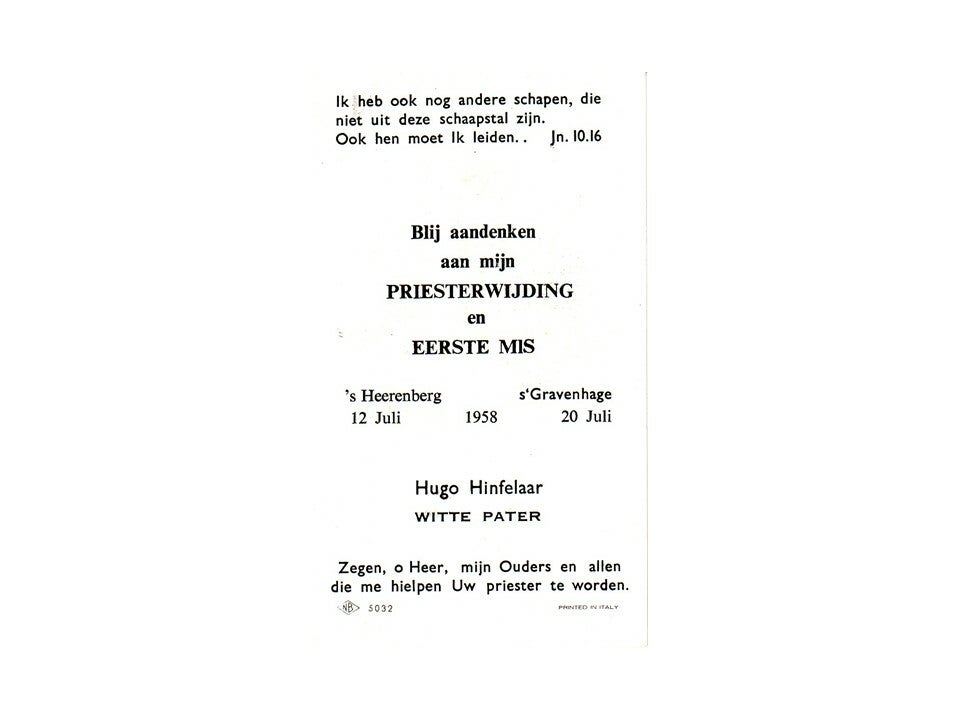
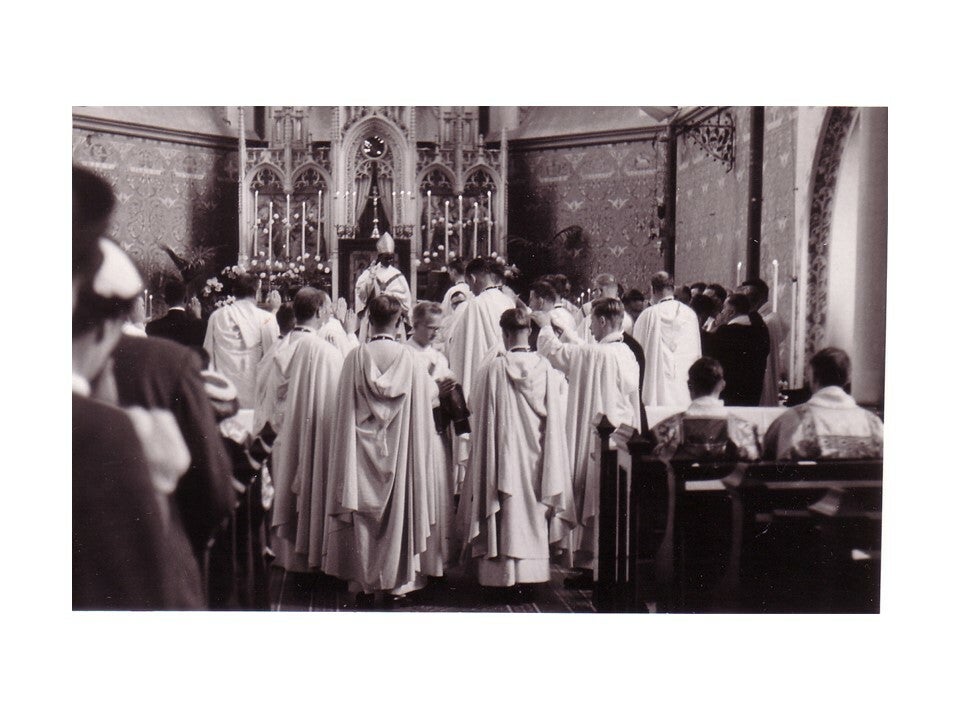
On 12 July my Dutch confreres and I were ordained in the parish church of s’Heerenberg. by Mgr Bigurimwami, a stately, and according to my sisters, very handsome Tutsi bishop from the diocese of Nyundo in Burundi. I mainly remember lying on the floor in front of the altar, happy that the moment had finally come[37].
After the ordination I received a beautiful chalice from my parents, sisters and brothers for which they had saved from their small pocket money for over a year[38]. While we were admiring the chalice the Dutch provincial, Fr Piet de Ruijter came nearby, bent over me from behind and said with a laugh:
“I have very good news for you. A retired secondary school teacher has offered his services to the junior seminary in Sterksel and will take your place. You are now appointed to Northern Rhodesia, not to the diocese of Mansa but to the diocese of Abercorn”.
I almost wept with joy. I had finally obtained what I yearned for since the end of the war in 1945.
He asked me if I was ready to leave in August as there was a place free in the chartered plane.
This seemed to me almost impossible. I needed time to say goodbye to my large family and had booked for a course in elementary medicine, organised by the Medical Mission Association,(Memisa) for young missionaries. Consequently I was booked for the next charter in December.
What to write about that glorious intermezzo between July and December?
I quickly changed the addresses on my 5 trunks and took them with me in the coach to The Hague. Later someone offered to take them to the new procure in Rotterdam for destination Northern Rhodesia.
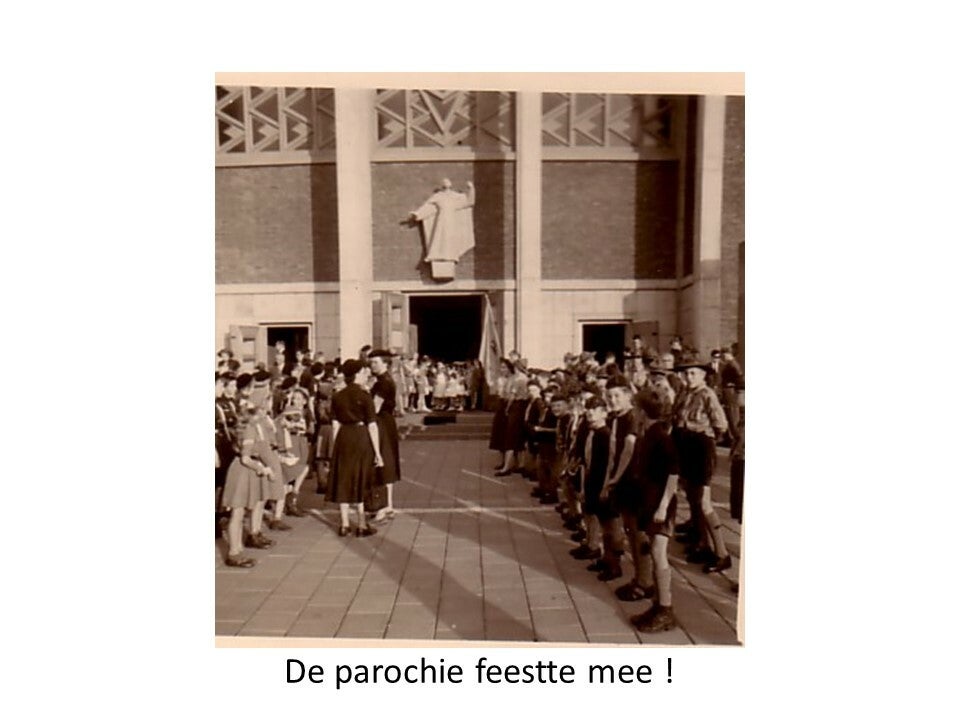
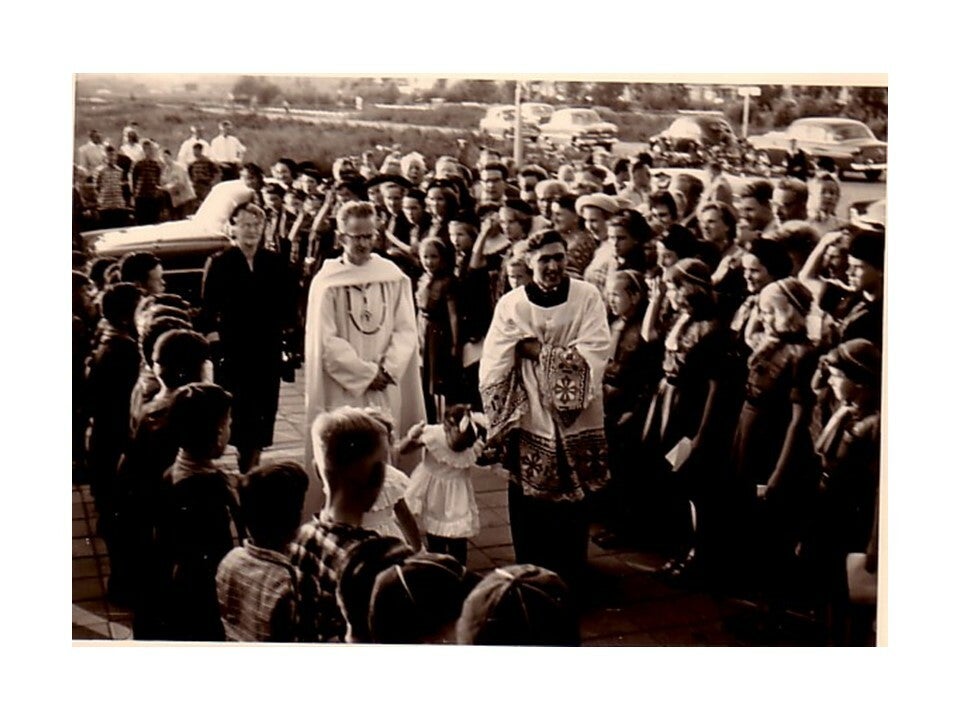
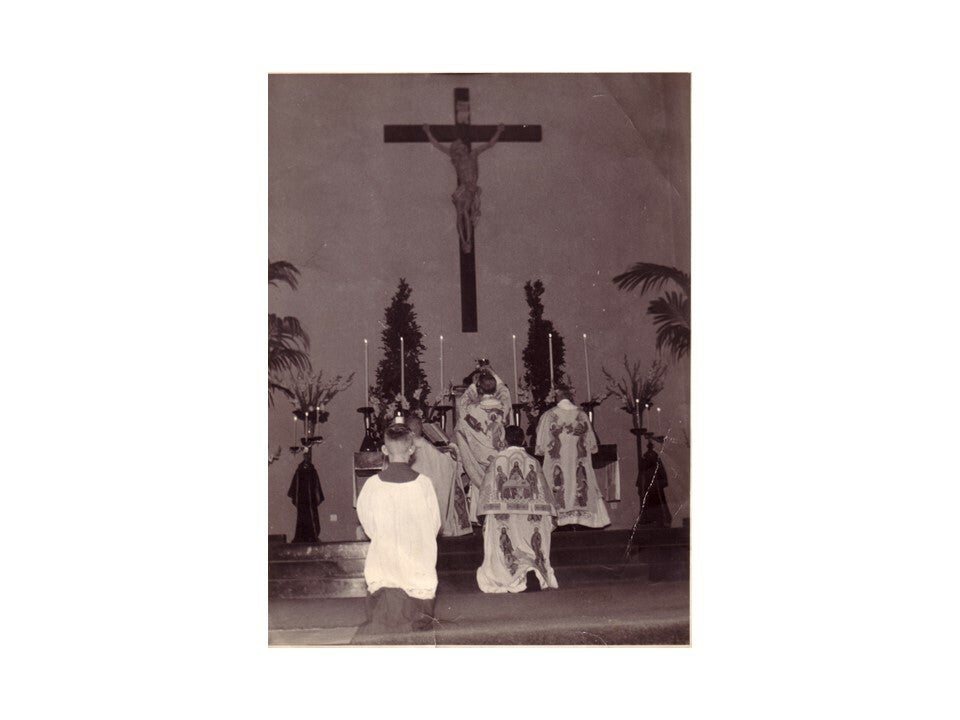
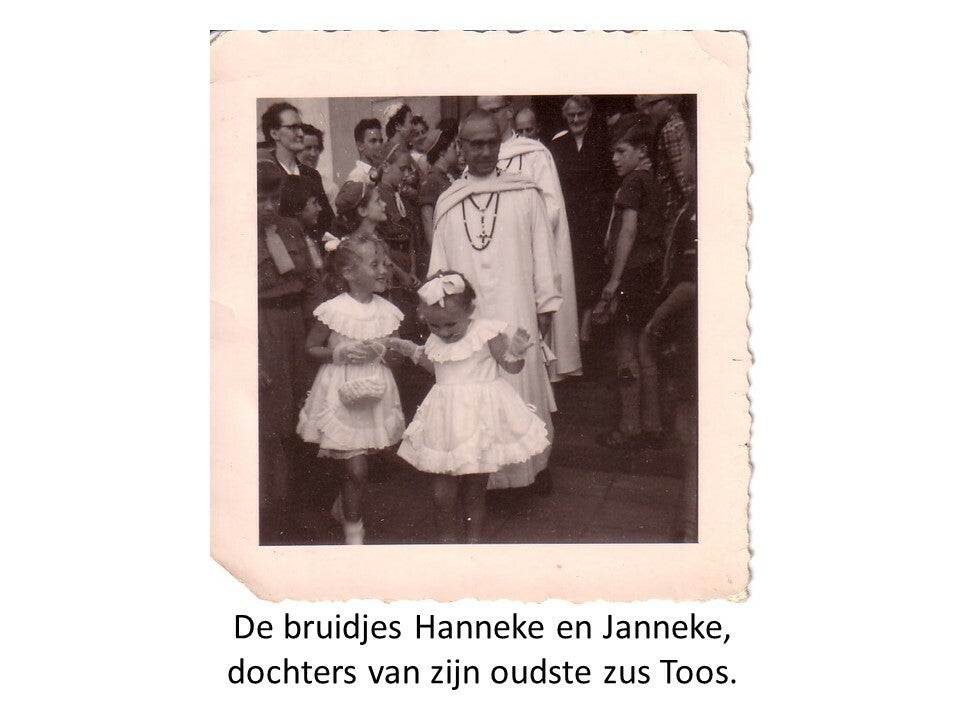
On 20 July I celebrated my first Mass in my home parish of St Paul’s in The Hague. All those who had known me during the hard days of the war, like the famous midwife of Loosduinen, Zuster Tholen, were present. It became a traditional village celebration with the brass band playing in front of our home, a triumphal arch formed by the scouts and the girl guides, a Mass of Palestrina sung beautifully by the parish choir and a long reception during which I received lots of presents and money ‘for the missions’ One of these presents was a portable typewriter that traveled with me until the present day[39].
My ordination was a great honour for the family, in particular for my parents.
‘Honour for what?’ I mused ‘until now I have done little, only studied on the cost of my family and friends!’
I was quickly called upon to exercise my priestly duties. The first baptism of a little baby girl of a parishioner nearby, followed by a week of assistance in a parish where the priest went on holiday.
I preached a sermon on Mission Sunday at the end of October and received an invitation by a friend of my youth, Piet VanSchie, to function as a chaplain to a groups of scouts. My younger brother, Jan, had successfully gone through his military service as commissioned sports instructor and courted Jeanne Peters, who lived near the corn mill of the historical Abby church in Loosduinen[40]. His first post as a young teacher was in Poeldijk, a market garden village in the Westland. He asked me to celebrate a Mass for the nuns who were in charge of the school where he taught[41].
That was followed by a week with sea scouts, who camped in the middle of a swampy polder, near the Kager Lake. I was impressed by their discipline and stamina as they had to combine the rules of scouts ‘on the land’ with those ‘on the sea’ I remember being rudely woken up in the middle of the night by the scoutmaster for a mock sea battle with other scouts, who camped nearby.
It became September, the holidays were finished and I started the Memisa course in Rotterdam on elementary medicine[42].
We were two White Fathers in that group of some 30 missionaries: my classmate, Herman Paul (Happy) Van Hasselt and me. He had, according to me, an unfair advantage as his father was a doctor[43].
I decided to go home each evening to spent as many days with my family as possible and traveled up and down from the Hague on a small red coloured motorcycle.
In the St Laurent’s hospital we given not only lessons on First Aid, but innumerable practical hints to be applied in situations when no doctor was available. We were taught how to give injections, pull teeth, and even assist at a difficult childbirth .
Meanwhile the cardinals in Rome chose a new pope who called himself John XXIII. He was an old man, a sort of interim pope, it was said. A neigbour in the Kokosnootstraat possessed a small black and white TV and called me in to see his face. I was disappointed to see a 77-year old man, called Angelo Roncalli, small and insignificant, so different from the austere and ascetic face of his predecessor, Pius XII.
Finally the day of departure came, the 9th of December. My family boarded the normal line bus to Schiphol but I made use of the free connection offered by KLM for its passengers. While waiting for the bus in the centre of the city, suddenly my favourite aunt Fie appeared out of the dark portal. She was the one who had come to our rescue on liberation day in May 1945 after the premature birth of my sister Nelty. From her poor income as a widow, she had saved a bag full of pennies and gave them to me without saying a word[44]. She kissed me, held me a long time to her ample bosom and said simply:
“Do your best, Hugo, and take care!”
She wiped a tear and disappeared down into the basement of one of the hotels where she made her living by preparing meals for the guests. I would never see her again. She died of cancer of the liver in 1961.
At Schiphol I was re-united with the clan. My younger brother, Jan, and his fiancée, Jeanne, had ordered coffee and cakes. The departure became a celebration and every time a plane took off my younger brothers and sisters cheered. The hall filled up with all kinds of missionaries for Africa, ready to board the chartered plane waiting on the apron. Suddenly the moment of saying good bye had come, the moment I had looked for all those years[45]. I could see that it was hard for both my parents but they did not say much. The charter company took a picture of all of us and I waived in the direction of the people on the balcony. It was the first time I was to fly and once seated I could not imagine that this bulky thing with all the luggage would be able to take off.
But it happened nevertheless and soon the plane disappeared into the gray skies of Holland and flew into the direction of Rome, our first stop We landed in the early afternoon, booked in a small hotel and were ushered almost immediately to the Vatican for an audience with the new Pope John XXIII.
When the doors opened for him to enter, four men arrived, with a small and tubby Pope high in a chair, the sedes gestoria, carried by four men. When he got out of it, he stumbled and said apologetically:
“I have still to learn this!” The people among the audience who understood Italian, roared with laughter.
Later, in 1961, the pope had obviously decided not to make use of this high chair. One of my confreres wrote of the same occasion: ‘Four men, looking sheepishly with a empty chair, entered with John XXIII waddling behind, grinning and shaking hands with everybody’[46].
Already then he mentioned his deep sense of solidarity with all human beings and his urgent desire to engage the world in a mutually beneficial dialogue. He spoke about a future ‘ecumenical council’ a new concept for us, young missionaries on our way to Africa[47]. But we came away with a feeling that a new era had begun.
Next day we continued our journey and flew towards Africa, while one of the missionaries celebrated the Eucharist in the plane. We landed in Wadi Halfa on the Nile where I slept for the first time under a mosquito net and heard the shrill noise of the cicadas. The next lap was towards Entebbe in Uganda, the end of the chartered flight.
On the third day our names were called out to board a small plane, a DC II (Dakota) for a landing in Tabora and from there on to Mbeya in Tanzania. There another Dakota was waiting to take us finally to Abercorn in North Rhodesia.
By then we were only 6 White Fathers left: two old timers , Fr Clement Domen and Fr Hein Ideler, and four new comers, the Canadians André Neault, Denis Bernardin, Piere Paul Boutin and me. The rainy season had started and when flying over lake Tanganyika the old war plane bolted and dived like a staggering horse. The sun was setting when the airfield of Abercorn came in sight. I could not believe that we would be able to land on a small open strip in a sea of green trees.
One of the old timers, Fr Hein Ideler became very excited during the slow and noisy landing. Wearing his sun helmet he shouted at us, young adapts,
“The time of you playing around, is finished now! You will have to work and become serious!”
We looked at each other and shook our shoulders. Hadn’t we come exactly for that?
Once out of the plane Fr Clement Domen made us kiss the ground and we complied obediently. It was the 12th of December. A resolute lady walked up to us. She was the immigration officer, custom and excise official, and caretaker of the airstrip all rolled up in one person. After she had told me that I did not belong to the Commonwealth and had to obtain an alien certificate as soon as possible, she got us all in her van and drove us without much ado to St Paul’s mission the home of the Catholic bishop of Abercorn.
His residence was not inside the small ‘Boma’ town but a few miles outside. It consisted of a chapel, and a few houses, with thatched roofs. It was Brother Fritz Koch who came out to welcome us. I had met him in Hörstel when building the novitiate. Later in the evening the apostolic administrator, Adolf Fürstenberg himself appeared. with a telegram in his hand. He had just been officially appointed by Rome as the successor of Bishop Vanden Biesen and planned to go to his home country, Germany, for his consecration.
After supper a bottle of cheap gin, whiskey beers and a few soft drinks were put on the table and the old hands celebrated our arrival plus the appointment of the new bishop.
To make a good impression in front of the bishop we kept devoutly to soft drinks. The more the bottles became empty, the more fantastic the stories of the old missionaries became, especially those of Clement ‘Baas’ Doomen. He advised us seriously always the leave two opposite windows open so that if a lion or leopard happened to jump in the room, it could easily escape again.
That night a big piece of termite-eaten thatch fell on the bed of André’s Neault. He screamed like a piglet as he thought that a lion had jumped in his room!
Next day Paul Pierre Boutin boarded a small private plane and flew with a couple of civil servants to his appointment in the diocese of Fort Rosebury. Baas Doomen took us to the village. People were on their way to Benediction in the mud brick chapel nearby. Once the Blessed Sacrament was exposed, they begun to sing so harmoniously that I got deeply moved and never forget that first impression. Baas Domen also wanted to test us on our hunting skills. He attached a small ‘bull’s eye’ on one of the trees and pushed a small rifle into the hands of André Neault. He proved to be a good shot. When it became my turn, I refused, as I had made a resolution after the war never to hold a rifle or a shotgun as a weapon in my hands.
Next day we went shopping in the little Boma town called Abercorn[48]. To my surprise this place, so seemingly ‘behind the sticks’, housed almost a hundred expatriates of different origins. There were the civil servants of the local colonial administration, a group of commercial farmers but also a great number of Europeans who worked for the International Locus Control. The Rukwa swamps in nearby Tanganyika were breeding areas of the feared red locusts whose swarms could destroy the crops within a few hours and cause serious starvation in Tanganyika, Northern Rhodesia and the Congo.
In one of the shops I bought a folding chair and table in one of the well equipped shops, which served me faithfully during safari’s up to this day.
The bishop told us that Brother Fritz Koch would give us a lift to Kayambi, the first permanent mission in Northern Rhodesia, founded in 1895. Its superior, Fr Jean Pierre Belin, was to teach us the language with the help of a new and modern method.
A week before Christmas, on the 17th of December, we climbed into a landrover and were finally on our way to Kayambi, a journey of about 170 miles, due South. Two of us, Denis Bernardin sat in the front while André Neault offered to sit in the back together with our luggage. To avoid dirtying his khaki working habit he took it off and made himself comfortable, dressed in a vest and shorts. We drove with considerable speed along a small dirt road through the endless bush, jerking and jumping over anthills and through pot holes. We stopped somewhere to eat our sandwiches and have a drink. Within a few minutes boys and girls appeared, seemingly out of nowhere. They laughed, cheered, insisted to greet us with a handshake and waved us off on our way.
‘What a cheerful people they are.’ I thought. I felt at home at once and decided then and there to learn their language as quickly and as well as is possible in order to be able to speak and laugh with them.
It was late afternoon when we drew up in front of the old mission buildings. The girls of the sisters’ boarding school were just leaving their classrooms and ran out to greet us, ululating and cheering loudly. They giggled without shame or reverence about Andre Neault in his shorts and vest and called him a musungu, a European. They peered at us in the front of the car and decided quickly that I looked like a mwaice, a little boy. This was the first Bemba word I learned[49].
The superior Fr Jean Pierre Belin, an ex pilot of the Free French, came out to greet us followed by the slower Fr Alfons Cox, nicknamed Kokoshi. They told us that there was not enough room in the Fathers house and that I had to occupy a room in the ‘mitanda’, the outbuildings next to the parish offices.
When I went to bed that dark evening and crept under a torn mosquito with dusty blankets that had not been aired for a long time, I felt for the first time that I was far away from home, from my parents and all my brothers and sisters. Strange sounds from exotic birds and possibly wild animals could be heard, coming from the bush nearby. The place felt so mysterious, remote but also inviting.
I had finally arrived were I wanted to be since my early youth and fell asleep content and ready to take the plunge.
[1] The house was so well built that in 2005 no demolition company accepted to break it down.
[2] In 1941 it became the barracks of the German occupying army and in 1944 it was partly used as an army hospital for the Allied troops. The White Fathers stayed there until 1958 when they moved their Scholasticate to London, U.K. It was then bought by the Salesians of Don Bosco.
[3] Fr Joseph Geerdes, born in Schiedam, near Rotterdam in 1915, died in Boxtel, 10-10-1977. Fr Jan Derks, born in Den Bosch in 1921, died in a car accident in Boxtel, 22-01-1964.
[4] Born 1900, Sherbrooke, Canada. First assistant of the Superior General, Bishop Louis Durrieu, in 1947. Died in 1982.
[5] Later, the ordination of Jan Rademaker was postponed as he played the organ during the preceding Retreat, a time of silence. He still works in the Congo under great difficulties but never touched the organ since then.
[6] Fr Joop Geerdes was appointed to Kampala in Uganda, in 1954. There he founded a Pastoral Institute called GABA and started the now well known church magazine AFER, Africa Ecclesiastical Review. He retired to the Netherlands in 1976 and died there in 1977.
[7] Among them even the two women, Miep and Sjurrie Visser, who managed the Hus Bakery on the corner of the street.
[8] Renault, Fr, 1994, Cardinal Lavigerie, Churchman, Prophet and Missionary, Athlone Press. London. P. 41: Lavigerie had a broad vision of the Church, not limited to Southern Europe but extended to the whole world. His aim was not to assimilate the Eastern Catholics but to help them to grow in the line of their own tradition. ‘The greatest and perhaps the only obstacle for the East is the imposition of Latinism’ he said. A balance had to be struck between an indispensable unity of which Rome was the centre and respect for legitimate diversity. He wrote: ’Do not confuse unity with liturgical conformity’.
[9] He was ordained in Rome in 1955 and was sent by his bishop for a doctorate. He arrived in the diocese of Makasa in 1958: Tablet, Obituary 9 June 2001, p.854. Adrian Hastings was born in Kuala Lumpur where his father practiced law. Educated at Douai and Worcester College, Oxford where he read History. He decided to become a missionary in 1947.
[10] Brian Garvey and Frank Nolan made up a language course with the use of the first tape recorders. Lionel Kearny came with a number of books written by Charles Dickens. Etc.
[11] Born in 1911 and ordained in 1937 he was 42 years old and a product of a pre-war asceticism. He never had real ‘bush-missionary’ experience but had taught theology until 1948 in the major seminary of Kipalapala in Tanzania. After three years lecturing theology in s’Heerenberg he was appointed novice master in 1952, an appointment he kept for many years. He died in the Netherlands on 24-12-1998, after work in the U.K. as novice master of the brothers.
[12] Canadians: Perrie Dumain and Jacques Letourneau, Belgians: Warren de Belser and Remi VanderWalle, Frenchmen: Pierre Federlé and Bermard Fagnon. Later the two Frenchmen left for military service in Algiers.
Joop Harding and Toon DeVos to Canada (after novitiate in the USA), Louis Broos, Toon Aarts and (later) Pieter Reesink to North-Africa, and Jan Rademaker and Jan VanHaandel to Heverlee in Belgium
[13] According to the decisions of the encyclical Aeterni Patris.
[14] Systematic Theology was summarized in a set of volumes, written by Fr Boyer, Moral Theology by Fr Noldin and Spirituality by Fr Tanqueray.
Cornelius Jansen (1585-1638), a bishop of Ypres, denied the freedom of the will, and maintained that it was not possible to keep some of God’s commandments Condemned in 1642, this narrow teaching had been revived by the Religious Sisters of Port Royal, towards the end of the 19th century.
[15] Interview by the author, 20 may 2003. Fr Geurts born in 1914, ordained in 1938, appointed to Karema, Tanzania, then rector of the WF Scholasticate from 1947 until 1956. He returned to Tanzania and enjoyed many happy years until his death in The Netherlands on 27-12-003
[16] Only much later we learned about the cruelties that were inflicted to people of both sides during this struggle for Independence.
[17] He was the founder of Mtendere parish in Lusaka Zambia and died 12-06-1996. Louis Oger , died 22-04-1996 and Jean-Pierre Belin, died 20-12-03 fought for the free French, etc.
[18] A dolefully sung narrative of a little boy from Rotterdam, employed to scrape boilers, who died in mid sea and is unceremoniously thrown overboard.
[19] Later, in Zambia, I learned that Fr Binkhorst had been the founder of Chibote Mission in 1910. He was born in 1880 and ordained in 1907 and died 30 May 1955. He was alleged to have put stones in the canteens of his carriers to make them of equal weight and so to avoid them complaining!
[20] Oacar became an archivist, see above. Lionel became a successful Social worker, married, had six children of whom one became a diocesan priest, the chaplian of Leeds University. Interview August 2004.(check proper info)
[21] Renault, F. 1994, p.396
[22] The British explained to us that in Scotland the word ‘cow’ was pronounced the same way as in Dutch.
[23] After his term as Provincial he worked for the Mission Council in the Netherlands and died in 1981
[24] During the Christmas holidays, 1956-57 the artistic Hans Pauwels made ‘stained glass’paper drawings for all our windows in the recreation room.
[25] There were almost professional comedians in our group, like Guus Beeckmans and Roger de Beijs.
[26] In Hörstel, I met Bro Fritz Koch (Corbinian) who later joined the Diocese of Mbala and give me a lift to the first mission Kayambi.
[27] Fr Chris O’Doherty was born in December 1923 and ordained in the Netherlands on 11th June 1949. In 1957 he was appointed to Tanzania. He died in Ireland 25th August 2004.
[28] In ’s-Heerenberg the bursar would buy an old horse from the farmers that eventually ended up on our tables.
[29] Later it was sold to the Film Star Oliver Reed and then came in the hands of an Insurance Company.
[30] Fr. Bernard Gaffney, born 1904, Lancaster, died 30 January 1991.
[31] One of them was Bro Chris Mullen, who later became Fr Stoker’s socius and then taught in the technical schools of various countries in central Africa.
[32] Later, he told us that he had trained not less than 700 future priests.
[33] Father James Smith, born in 1904, returned later to Uganda and died in Rubaga on 28 September 1985.
Fr Jan (Joop) Bessem was born in 1926, ordained in 1953, and worked later in the major seminary of Katigondo and Nairobi, as a development Agent. He died exhausted on 26th March 2000.
[34] Fr Theodore Moorman, born in 1880, died in Heeten, in the Netherlands, on 6-7-1979, almost 100 years old.
[35] The Archbishop loved to do this for the White Fathers and towards the end of life was proud to have ordained a total of 100 White Fathers!
[36] Later my youngest sister, Carla, who was then just 8 years old, told me that she remembered me as someone who always caused a celebration.
[37] Of our class Joop Harding and Toon DeVos were ordained in Canada on the 1st of February. Louis Broos, Jan VanHaandel and Piet Reesink in Carthage, on 3rd of February, Toon Aarts and Jan Rademaker in Heverlee, Belgium, on the 6th of April, Wim Settels on the 7th of May in Galashiels, Scotland, and Theo Winkelman, Jos Planken, Happy VanHasselt, Harrie Weghorst, Herman Schuur, Hand Peters, Piet Kooiman en Hugo Hinfelaar in ’s-Heerenberg, Netherlands.
[38] Made by the well known jeweler and goldsmith Mr Kroll from The Hague. I still have the original invoice: a total of 450 Dutch florins.
[39] In contrast with the expensive computers that disintegrate or are called out of date after a few years!
[40] Jan started the Teacher Training in Sept.1951, and passed in June 1955. He met Jeanne in July 1955, did his military service from August 1955 until April 1957and married Jeanne in August 1959.
[41] They married in 1959, had three sons in The Hague and they moved to a small village near Amersfoort. There he specialised in teaching methods of Children with Learning Difficulties, and became the head of this department in Amersfoort. One the 22 April 1969, their last child, a daughter was born, called Marja. She would play a great role in my later life.
[42] The course was ably organised by a Mrs VanDerLugt, known and beloved by many missionaries.
[43] In December 1958, ‘Happy’ left for the diocese of Mzuzu in Malawi. Born in 1930, he was diagnosed to have cancer in 1999 and died in the Netherlands on 21-11-2000.
[44] After having been ‘in service’ she married a young man , called Engels who soon died of T.B. Se never re-maried and lived on her own income as a maid-in-service.
[45] Later some of the die-hard missionaries would remark a bit sarcastically : When a missionary leaves for the first time, he is happy but his family weeps. When he goed for the second time, he is sad to leave but the family is hapyy!!!
[46] [46] Interview Fr. P. Harrity April 2002).
[47] On 25th January 1959, in the presence of all the cardinals, he repeated his desire and suddenly ‘ like a flash of heavenly light’ announced the holding of the Second Vatican Council.
[48] Its name was changed into Mbala after Independence in 1964.
[49] A good number of these Standard three and four girls went to Ilondola for St. V and VI. Some of them became the wives of the first Zambian leaders and senior civil servants.
'